

.png)
.webp)


.webp)


.webp)



In this episode of Heroes of AR, Pradyut Hande, Associate Director of Product Marketing at Growfin, sits down with Thomas Conforti, who handles credit and collections management at Roehm, a leading global chemical manufacturing company, to unpack what it actually takes to manage AR in one of the most operationally complex B2B environments.
The conversation covers pricing volatility in commodity chemicals, the role of cross-team collaboration in keeping receivables healthy, why AR teams are often the first point of contact when things go wrong, and the surprisingly simple playbook behind consistently low past dues.
PH: You work at Roehm, which is a leading manufacturer in the methacrylate business. What makes credit risk in the chemical industry structurally different from other B2B industries?
TC: We're a commodity chemical manufacturer as opposed to specialty, meaning pharmaceutical. That creates a different dynamic. Pricing can go up and down from month to month depending on how the market is, as opposed to contractual pricing that stays locked in. We don't have a lot of blanket order POs.
The bigger challenge isn't really disputed items from pricing. It's more a matter of what the left hand doesn't know what the right hand is doing. The buyer and sales may have agreed on a new price for the next month, but the accounts payable department hasn't been updated yet. They need the buyer to approve it. Those are the kinds of dynamics we deal with regularly.
Common AR Breakdowns in Volatile Pricing Environments
PH: Given that pricing fluctuation and volatility, what are some of the most common AR-related breakdowns you've seen? And how do you design contract terms to prevent them?
TC: Luckily, we're all on the same team at this company. I'm very pleased that we have a fantastic sales team and everybody is on the same page. So contract terms don't usually become a battleground. There are going to be customers from time to time who unilaterally say, "We're going to net 60 from net 30," but those get addressed pretty quickly.
Where it gets interesting is with mid-range customers in terms of dollar volume. If there are ever issues where a customer starts changing terms or paying slow, our sales team is very reactive. In a lot of those instances, the sales rep has already gone to bat for that customer, whether it's pricing considerations or product allocation. Our plants run 24/7, so when a rep has fought to get a customer extra product or a good price, they really don't like it when that customer starts playing games. Those situations get addressed very quickly, and it makes my job a lot easier.
TL;DR In commodity chemicals, pricing volatility creates AR friction, but it's rarely about contract disputes. The real breakdowns happen when internal teams aren't aligned on pricing updates. A strong sales team that holds customers accountable is the first line of defense.
Why Collaboration Can't Be an Afterthought
PH: That puts a lot of onus on intra-team collaboration. You can't have this information sitting in silos. How does this shape up at Roehm?
TC: We have very good collaboration among finance, customer service, and sales. We're constantly communicating with each other, not just about order releases or the standard things you'd normally associate with credit and AR.
Globally, there's a report we produce - myself and counterparts around the world - covering the top 10 past due accounts, and we report on this weekly. Senior management is very on top of it. Any major issues are going to be highly visible. Sales may get asked questions about what's going on. It's a daily process. We don't even have to think about the collaboration. It's just part of how we operate.

TL;DR Collaboration at Roehm isn't a quarterly initiative or a Slack channel. It's a daily operating rhythm, reinforced by global weekly reporting on the top 10 past due accounts with full visibility up to senior management.
Resolving Payment Delays Without Damaging Relationships
PH: What's the fastest path you've adopted to resolve payment delays or disputes without damaging customer relationships?
TC: The first thing is, if something is blocked, we go right to customer service and/or sales depending on the situation. Sometimes we don't know the reason for the block. When you're dealing with third-party or outsourced accounts payable departments, they might flag something as a price issue when it's actually a quantity issue. One is a function of the other, of course.
With larger companies, you're not getting a direct contact. It's going to a group email box. The AP department might respond quickly that something's blocked, but they may not have the specific reason. So what we do first is find out from sales and customer service: was there an issue with this shipment? Was it a return? Was there a pricing problem? Then we proceed from there.
TL;DR Speed in resolving payment delays comes from going straight to the internal teams who have context, not from chasing an outsourced AP department for answers they may not have.
AR as a Relationship-Building Function
PH: How have you seen AR actually be a lever in terms of bolstering customer relationships?
TC: There are a few things. First, you mentioned AR being the final touch point with customers. Ironically, there are a lot of instances where we're the first point of contact when there's a problem. That doesn't mean customer service or sales isn't responding, it just means AP or whoever is going to call us first when they notice something. That's a terrific opportunity to build a relationship. Somebody emails you or calls you - pick up the phone, email them back. Don't wait a business day. When you reply, copy all the right people. If it's someone you haven't communicated with before, just common courtesy: "Very nice to meet you. I'm happy to help. I'm your contact here at Roehm."
The second thing, which is near and dear to my heart, is contacting purchasing directly. Years ago, it was drilled into you that purchasing deals with sales and credit deals with finance, and there's no mixing of the two unless there's a serious situation. That's evolved quite a bit.
We can contact buyers directly when there are issues, and it's never confrontational. We'll say, "Accounting is showing this as blocked. Do you need anything from us? How can we help?" In years past, buyers used to get calls like, "Your payment is blocked. What's going on?" That approach has changed.
One of the successes I've had is getting buyers added to receive original invoices alongside AP. Most ERP systems - SAP, Oracle, others - have the capability to send invoices to multiple email addresses. Not everybody agrees to it, but the larger customers tend to. And you don't need a lot of those to make a big difference. When monthly pricing discrepancies arise, accounting sees something blocked and purchasing sees it at the same time. It resolves that much quicker.

TL;DR AR teams are often the first touchpoint when problems arise, not the last. Treating that as a relationship-building opportunity, especially by engaging purchasing directly and adding buyers to invoice distribution, accelerates resolution and strengthens trust.
The Playbook Behind 5.5% Past Dues on a $40M+ Portfolio
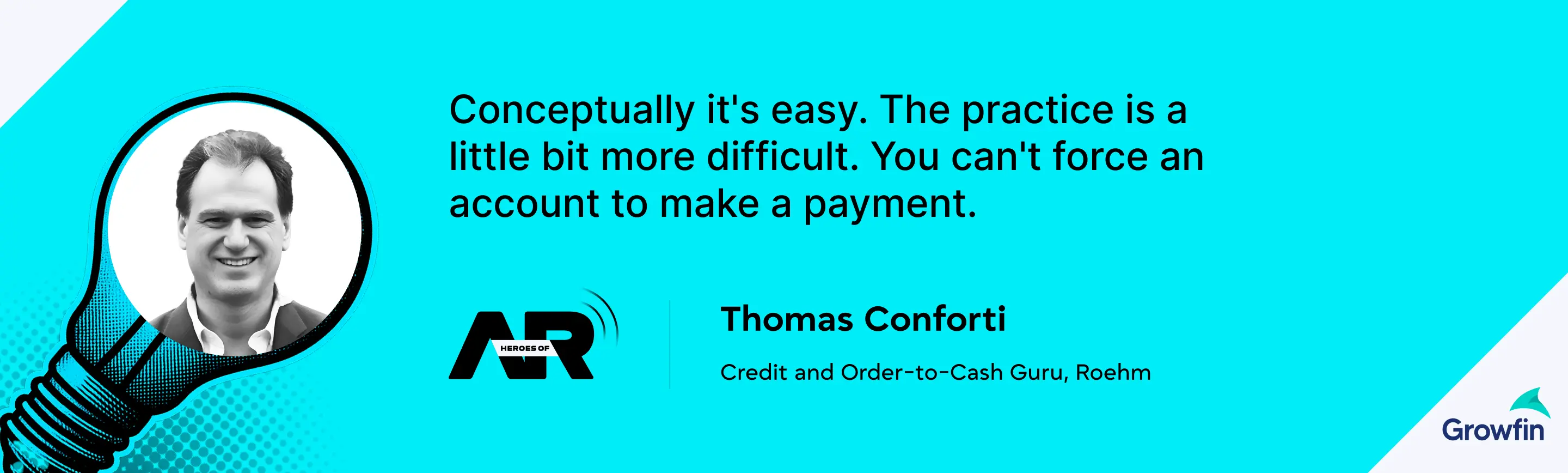
PH: You're managing a portfolio of over $40 million and you've kept past dues under 5.5% consistently. That doesn't happen by accident. What's the playbook?
TC: The first thing is it's part of our job requirement and our goals. That's the mantra. When Roehm America was carved out of Evonik, the directive given to credit was: we don't allow past dues. There are no past dues allowed.
As far as the actual playbook, globally we report on the top 10 past dues by division every week. Senior management in Germany reviews it. The major dollar items are highly visible. For monitoring, something very simple but very effective: you can run an aged trial balance as of a future date and see what's coming due. We run ATBs weekly, see what's approaching, and if there are accounts we're concerned about, we get in touch before they go past due.
For month end, quarter end, and year end specifically, we tend to call in favors. We have a lot of good customers who pay on terms, but it's rare that you get payment right on the due date. So when month end comes around, we'll reach out directly or ask a salesperson to check whether a customer can do a same-day payment on that last Friday or even pay an invoice a day early. With large dollar accounts, you don't need many of those to make a big difference in your snapshot past dues.
TL;DR The playbook is deceptively simple: make zero past dues a non-negotiable goal, run forward-looking ATBs weekly, maintain global reporting visibility, and leverage strong customer relationships to pull payments forward at period end. Consistency is the strategy.
The Role of Trade Credit Associations
TC: One thing I want to add - industry trade credit associations are a fantastic way to help you monitor accounts. You talk to people, email them, ask for references. Roehm is a member of a great trade organization, the National Association of Credit Management, under the chemical industry group CADEX. You've got direct contacts. It's not like a D&B report where you don't know who the company is. We have company names and direct contacts. If someone's paying a little slower, you can see it. That's how you can also be proactive.
TL;DR Trade credit associations offer direct, named contacts and real-time peer intelligence that credit reports can't match, making them a powerful early-warning system.
Technology and AI in Manufacturing AR
PH: How do you see AI and automation coming together to elevate credit and collections decisions for AR leaders?
TC: AI is going to come into financial and credit functions in manufacturing environments. I think AI solutions might be more applicable initially to retail, consumer packaged goods, or SaaS industries that have high-volume transactions, as the next generation of dunning automation. For those kinds of industries, AI is the natural next step.
For manufacturing, where we're seeing it first is on the order-to-cash side with no-touch OTC. A customer sends over their PO via email, and as long as everything matches, the order gets entered into the system automatically. We've implemented that in one of our divisions. It's early days, but that's where manufacturing is going to see AI making an impact initially.
At some point, it will touch manufacturing credit more directly. But the journey starts with process automation on the OTC side before it reaches collections and credit decisioning.
TL;DR In manufacturing, AI is entering through no-touch order-to-cash automation first, not collections. High-volume industries like retail and SaaS will likely see AI-driven dunning and collections earlier, but manufacturing credit will follow.
What Separates Average from High-Performing AR Teams
PH: What actually separates an average credit and collections team from a high-performing one?
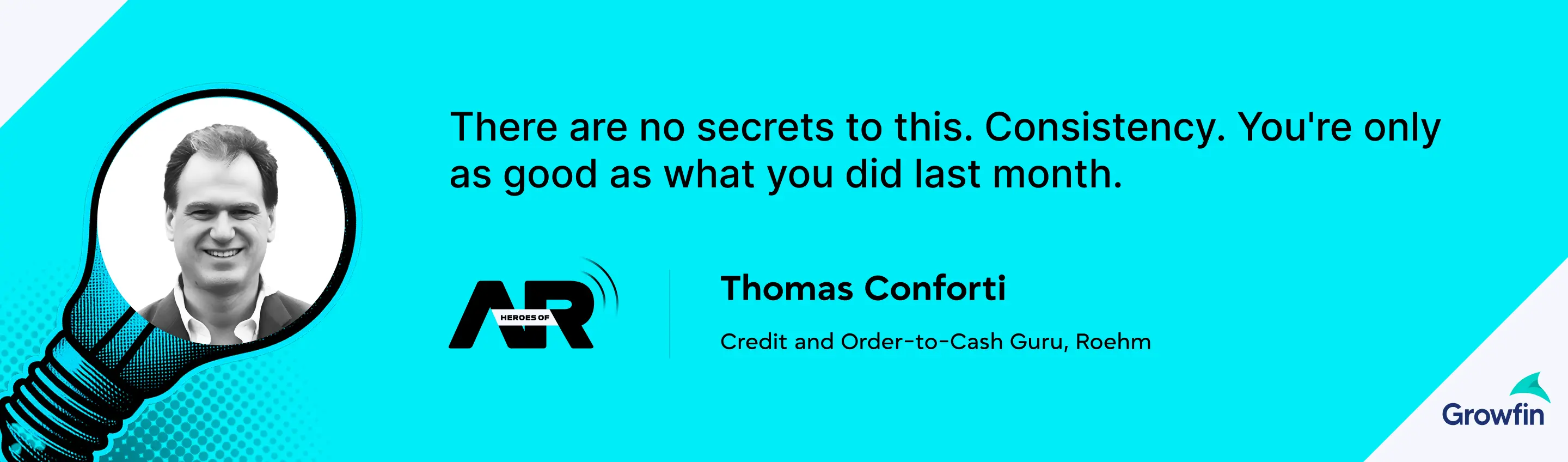
TC: Consistency. There are no secrets to this. You can't rest on your laurels. As the song goes, "What have you done for me lately?" You're only as good as what you did last month. It's great that you hit your year-end numbers, but if things go south the next month, that's no good.
One thing I want to call out: if you notice an account where sales volume has dropped off, don't take it for granted. In commodity chemicals, maybe pricing is too high one month and they sourced elsewhere. Sure, that happens. But if someone's volume is dropping, you have to ask - is it because they're struggling? Keep the dialogue open with sales.
I'd recommend this for everybody: choose your interval - monthly, quarterly, bi-weekly - but have regular meetings with your sales teams. It doesn't always have to be about problems. Those mid-range accounts are where you can make a lot of improvement. You're always going to be focused on the high-dollar items and the seriously past due accounts, but the mid-range is where the untapped opportunity sits. Maybe a customer isn't disputing net 30 terms but only has one pay cycle a week. Can you get them to pay twice a week? Those conversations matter.
Use the tools you have available. Run your ATBs anytime you want. Run them as of a future date. Utilize your calendar reminders. And escalate when necessary. You can't email somebody four times, get no response, and expect to resolve it.
TL;DR High-performing AR teams are defined by consistency, not one-time results. Regular cross-functional meetings, proactive monitoring of volume shifts, attention to mid-range accounts, and willingness to escalate are what separate the best from the rest.
Final Takeaways
- Pricing volatility creates AR friction, but alignment fixes it. In commodity chemicals, the real issue isn't disputed contracts. It's when sales, purchasing, and AP aren't on the same page about pricing updates.
- Collaboration isn't a project. It's a daily rhythm. The best AR teams don't schedule collaboration. They build it into weekly reporting, daily communication, and shared accountability with sales and customer service.
- AR is often the first touchpoint, not the last. When problems arise, AP calls credit first. Treating that moment as a relationship opportunity rather than a collection call changes everything.
- Engage purchasing directly. Getting buyers on invoice distribution is a small change that dramatically accelerates resolution of pricing-related blocks.
- Simple tools, used consistently, beat complex systems. Forward-looking ATBs, weekly reporting, calendar reminders, and period-end outreach are all it takes to keep past dues under control.
- Watch for volume drops. A decline in customer order volume isn't just a sales signal. It could be an early warning of financial trouble. Keep the dialogue open.
Check out Growfin's collections and cash application solution, and start building your AI-driven AR processes.


.webp)
.webp)

.webp)
.webp)