

.png)
.webp)


.webp)


.webp)


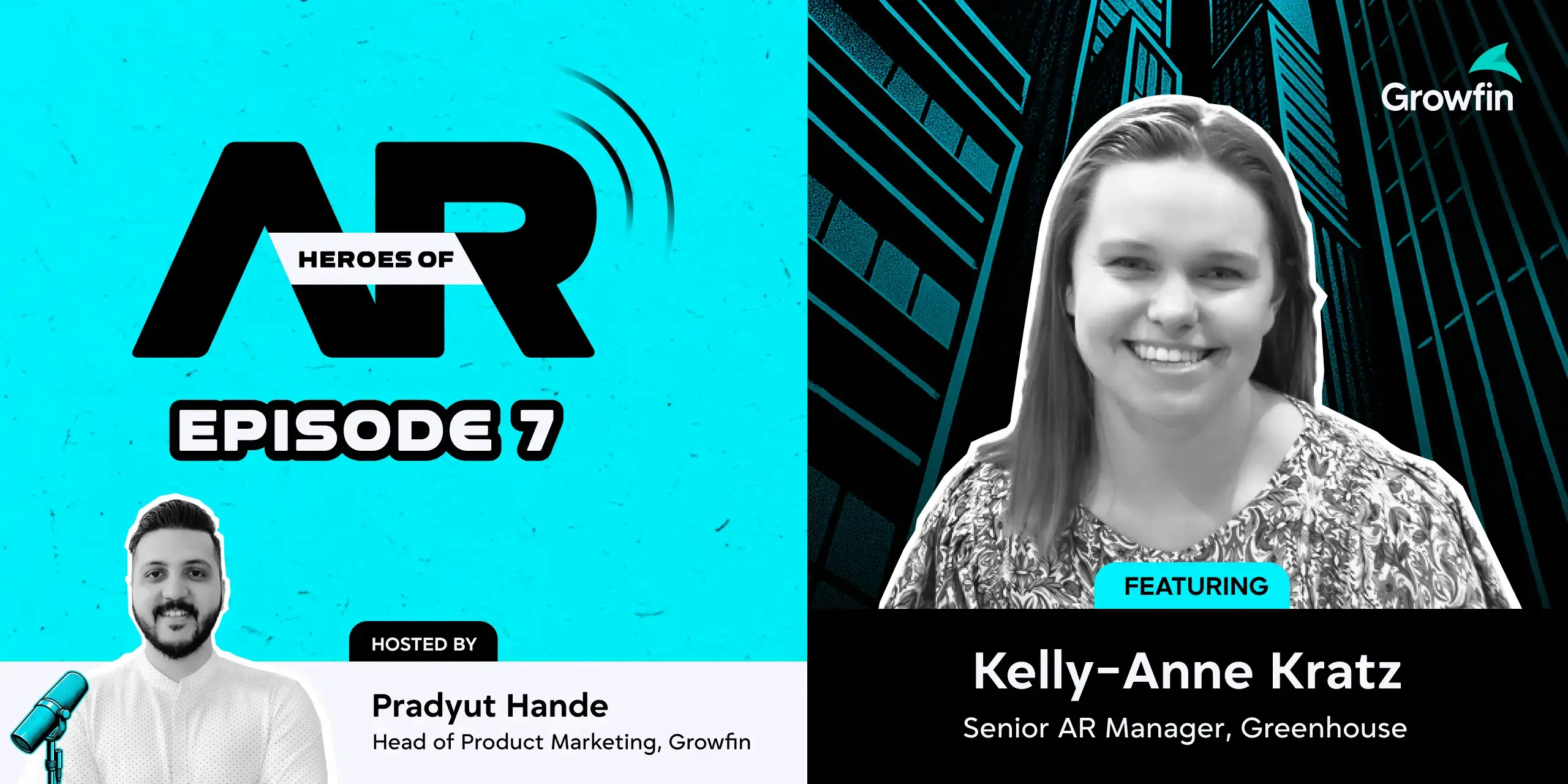
In this episode of Heroes of AR, Pradyut Hande, Associate Director of Product Marketing at Growfin, sits down with Kelly-Anne Kratz, Senior Accounts Receivable Manager at Greenhouse, to talk about what it actually looks like to build an AR operation from scratch inside a high-growth SaaS company.
PH: When you first stepped into the AR function at Greenhouse, what did the day-to-day operation actually look like? And when did you realize it wasn't scalable?
KK: I have a pretty unique story. I joined Greenhouse in January 2020, about eight to ten weeks before the world shut down. At the time, I was the first person hired specifically for accounts receivable. Before me, a revenue accountant and a revenue manager would dip their toe in when they had the chance. Someone would handle some cash applications one day, someone else would do some collections another day. But there was no dedicated resource.
When I came in, the aging was a bit of a mess. About half the book was past due. I had a lot of work ahead of me, because I wasn't just cleaning things up - I was building processes and procedures from scratch. Every time an issue crossed my desk, I knew it would happen again. So instead of just tying it up with a bow and moving on, I'd use it as the foundation for a repeatable process.
I also came from a hardware company, so I was new to SaaS. The dynamics are completely different. I knew almost immediately that the status quo wasn't going to be scalable, especially at the rate Greenhouse was growing.
Learning Customer Segmentation the Hard Way
PH: You achieved a level of customer segmentation pretty quickly at Greenhouse, splitting your approach across enterprise, mid-market, and SMB. How did you draw that line?
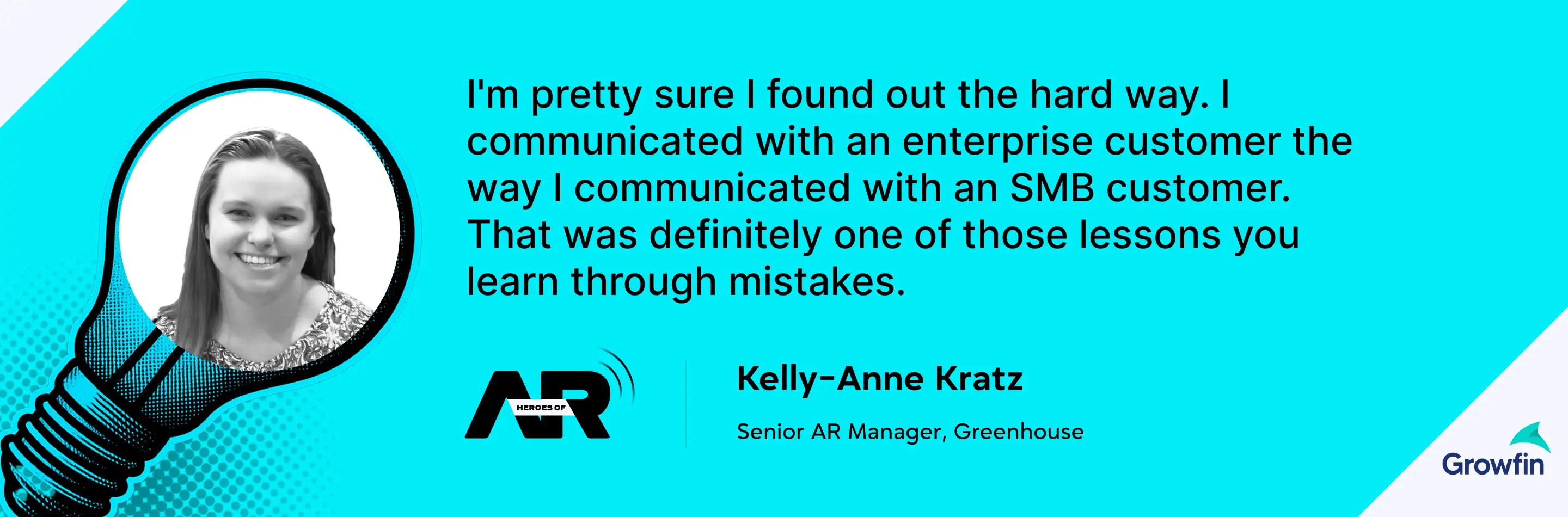
KK: I'm pretty sure I found out the hard way. I communicated with an enterprise customer the way I communicated with an SMB customer, and that was definitely one of those lessons you learn through mistakes.
In SaaS, the relationships are different, the renewals are different, the touchpoints are different. A lot of SMB and mid-market customers will just give you a credit card and that's it. Enterprise customers have procurement teams, purchase orders, contracts that need to be signed and reviewed. That standard net-30 looks completely different for someone at an enterprise company versus an SMB.
Once I realized that, I came up with different lines of communication and different outreach procedures for each segment. Small changes, but they made all the difference. The biggest game changer was overcommunicating expectations - letting enterprise customers know exactly what was expected of them and by when.
TL;DR In SaaS, you can't treat all customers the same. Enterprise, mid-market, and SMB segments require different communication styles, different outreach cadences, and different expectations around payment timelines. Kelly-Anne learned this firsthand and built segment-specific playbooks as a result.
From Paper Invoices to Digital Trails
PH: You went from hardware to software. What were the key differences you sized up quickly?
KK: One of the transitions that surprised me the most was around communication. At my last company, I was physically printing and mailing invoices to customers, putting them in the mailbox. If someone is on the other side of the country or the globe, that could eat up 10 of their net-30 days just in transit. And you don't even have proof it got there.
When I came to Greenhouse and everything was already digital, done via email, it was the best thing ever. There's a paper trail for everything. And that's one of my favorite things about Growfin - you can see timestamps on everything. Not in a "gotcha" way, but in a way that proves we did what we were supposed to do when we were supposed to do it. When you're dealing with hundreds of invoices on a monthly basis, there's no way I'm going to remember what I sent out on April 2nd of last year. But it's all there, so I don't have to worry about it.
TL;DR Moving from paper to digital invoicing isn't just about speed. It creates accountability, proof of delivery, and a searchable audit trail that makes everything downstream - collections, disputes, audits - dramatically easier.
One AR, One Team: Why Kelly-Anne Doesn't Divide the Book
PH: You live and breathe this "One AR, One Team" philosophy. It sounds simple, but how do you actually stop cash apps, collections, and disputes from becoming separate worlds?
KK: I love when people ask about this because it's actually a bit controversial in AR. When I talk to other leaders, they're always shocked. A lot of people at SuiteWorld were like, "You do that? And it works?"
Here's how it works: I don't segment out customers to my direct reports. I don't split the alphabet three ways. Everybody touches everything. And there are a couple of reasons for that.
I like to use the analogy of winning the lottery. If one of my team members sends me a message tomorrow morning saying, "Hey boss, I won the jackpot, have a good life, I'm going to my private island" - first I'm going to congratulate them, then I'm going to ask if I can come. When they say no, I'm going to get to work. But when I deliver the news, there won't be any panic. There's no "but they handle this, who's going to do that now?" We don't have to worry about it.
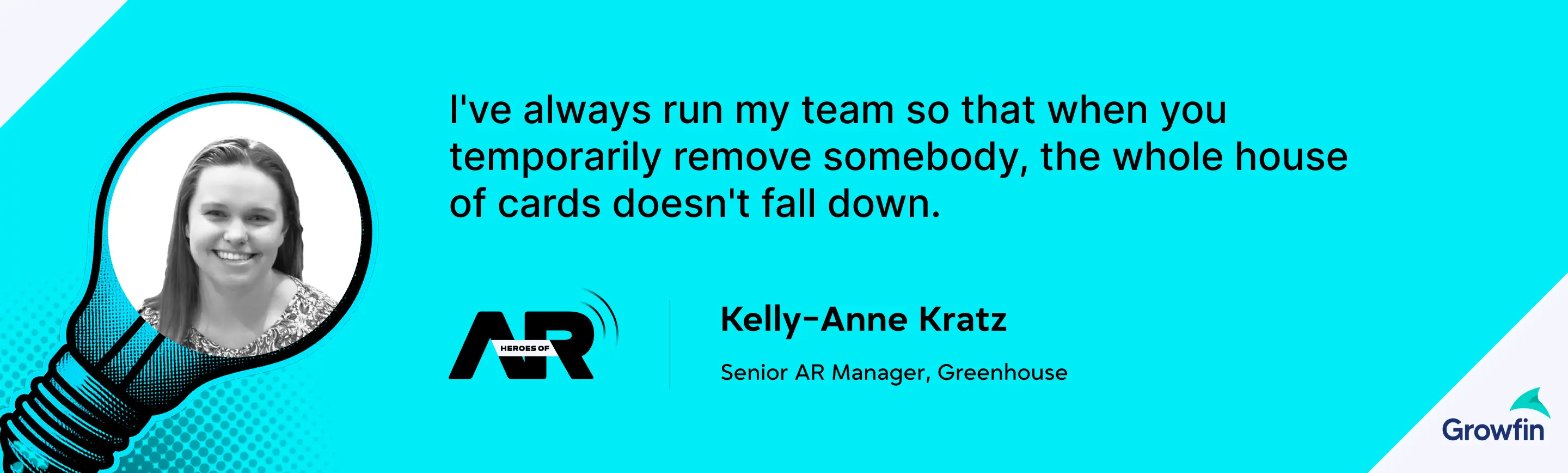
And there's a more realistic version of this too. A couple of years ago, I lost my mom very suddenly and I was out for two to three weeks. There weren't a lot of holes that needed to be plugged. Things happen - good, bad, or indifferent. People pass away, people get sick, people go on vacation. I've always run my team so that when you temporarily remove somebody, the whole house of cards doesn't fall down.
The way we make it work is really good recordkeeping. At any point, anybody can go onto any invoice, any account, and see what's going on in real time. Every interaction with a customer gets a quick note. It doesn't have to be perfect - sometimes words are misspelled - but it's there for us to get a pulse on what's happening. I can pick up where a colleague left off and confidently reply to a customer because I can see what the latest update is.
When customers interact with us, they don't see Kelly-Anne versus Bob versus Sally. They see accounting at Greenhouse. We represent one team. And it creates an environment where there's no finger-pointing, no "that's not my job." Everyone owns and cares about every single part of the journey from invoice to collected cash.
TL;DR Kelly-Anne doesn't assign customers to individual collectors. Everyone touches everything, backed by detailed real-time notes on every account. The result: no single points of failure, seamless coverage during absences, and a team identity that customers experience as one unified function.
Where Automation Should Take Over - and Where It Shouldn't
PH: How do you decide what should be automated and what should remain human?
KK: The collections process is the perfect example. I fully believe in automating that first stage - the gentle reminders a couple of days before an invoice is due, the gentle reminders a couple of days after, and any periodic reminders after that. Once the customer replies, that's when we take over.
Because the answer isn't always black and white. Sometimes it's a service issue. Sometimes they couldn't reach their account manager. Sometimes the people cutting the checks weren't in the room during the contract negotiation, so they have follow-up questions. These are multi-year contracts. Customers want to make sure they're investing in the right product and understanding their terms correctly.
So as far as collections goes, the initial phase of reminders and past-due notifications works really well with the AI piece inside Growfin. But once we get that response back and it's not a remittance, we take over the conversation. We use our judgment as leaders in this space to make calls, pass things to the right person, and figure out the next steps. There's a lot of thinking that goes into it once you get the reply. But before you get the reply, having templates and outreach strategies automated just makes things so much easier. There are thousands of customers and only four of us, so there's only so much we can do.
TL;DR Automate the first wave of collection outreach - pre-due reminders, past-due notifications, periodic follow-ups. But the moment a customer responds with anything other than a remittance, a human needs to step in with judgment, context, and the ability to route the conversation to the right person.
Why Audit Season Should Never Feel Like Chaos
PH: We're in the thick of audit season. What becomes critical during this period, and how can teams avoid the last-minute pressure?
KK: My hot take is that as far as AR goes, audit readiness isn't a once-a-year thing. It's an every day, every week, every month thing. If you're applying cash correctly every single day, invoicing correctly every single day, collecting periodically, and doing all the small steps throughout the year, your audit season should not be chaos. It should be a list of things to pull, compile, and send back to the auditor.
I like to compare it to training for a marathon. You can't sign up for the New York City Marathon next week and be ready for 26 miles. But if you start running a little bit every single week, you build up the stamina. The audit is the marathon. You prepare for it all year round.
I actually got an audit request last week. Twelve line items. It was the end of my day - full transparency, I was working from the couch at 4:45. I got it back within 15 to 20 minutes. The most tedious part was saving the PDFs and dragging and dropping them. Everything was already there. Payments were applied where they were supposed to be. Dates matched. Dollar amounts matched. And for the rare one-off items in past audits, there are always notes attached explaining why something is off, with documentation included.
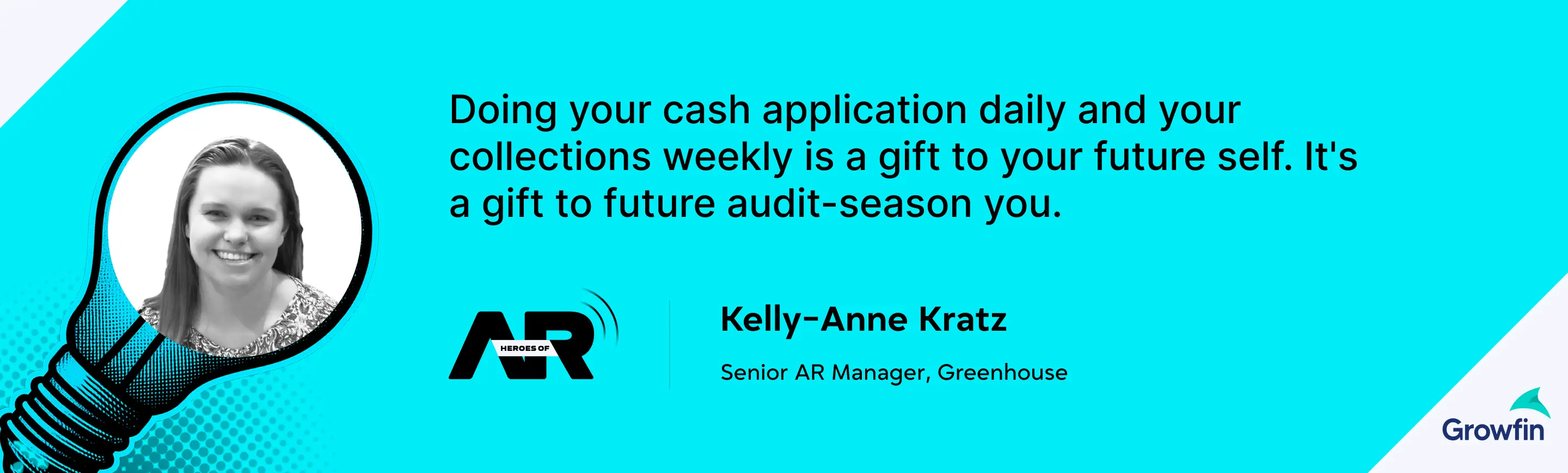
Quote me on this: doing your cash application daily and your collections weekly is a gift to your future self. You're taking five minutes of your day right now so that in February or March, there's no drama.
TL;DR Audit readiness is built in daily habits, not last-minute scrambles. Clean cash application every day, consistent collections every week, and thorough notes on exceptions mean that when the audit request arrives, it's a 15-minute task, not a week-long fire drill.
The Core Three: Cash App, Collections, Communication
PH: What's the one lesson you'd share with another AR leader so they don't have to learn it the hard way?
KK: It comes down to your basics. Don't focus on the crazy big processes. Focus on the core three: cash application, collections, and customer communication.
Start with cash app. When your bank reconciliation is clean, your aging is clean. When your aging is clean, you can move on to collections. Then you can move on to outreach and customer communication. Think of it like your personal finances - you get paid every other Friday, make sure that money hits your account, then you can start paying bills, go grocery shopping, go out to dinner with friends. If the money isn't where it's supposed to be when it needs to be there, everything is off balance.
If I were starting at a new company tomorrow, the first thing I'd do is review the cash application logs. Make sure they look pristine, down to the penny. Then I can confidently move on to the next thing. Your aging is your bible. You've got to make sure it's up to date.
TL;DR The foundation of great AR is deceptively simple: get cash application right first, then collections, then customer communication. Everything downstream depends on clean cash posting. If your aging isn't accurate, nothing else matters.
Final Takeaways
- Build processes from problems, not around them. When an issue crosses your desk, don't just resolve it. Use it as the foundation for a repeatable process that prevents it from happening again.
- Segment your customers deliberately. Enterprise, mid-market, and SMB customers require fundamentally different communication, timelines, and expectations. One approach doesn't fit all.
- Don't divide the book. Training everyone on everything and maintaining real-time notes on every account eliminates single points of failure and creates a genuinely resilient team.
- Automate the first touch, humanize the conversation. Let AI handle reminders and notifications. But the moment a customer responds with something other than a payment, a human needs to take over.
- Treat audit readiness as a daily habit. Clean cash application every day and consistent collections every week mean audit season is a 15-minute task, not a crisis.
- Master the core three. Cash application, collections, and customer communication. In that order. Everything else follows from getting these right.
Check out Growfin's collections and cash application solution, and start building your AI-driven AR processes.


.webp)
.webp)

.webp)
.webp)