

.png)
.webp)


.webp)


.webp)



From manual credit reports to AI-powered risk intelligence, the credit function is evolving from a back-office gatekeeper into a frontline growth driver. In this episode of Heroes of AR, Pradyut Hande, Associate Director of Product Marketing at Growfin, sits down with Jordan Esbin, Founder and CEO of Credit Pulse, to explore how modern credit management intersects with accounts receivable - and why getting credit right can unlock millions in additional revenue.
The conversation covers everything from the hidden costs of weak credit decisions to the power of organizational alignment between credit and collections teams, and why technology should always follow people and process - not the other way around.
PH: Before we get into the nuances, can you tell us about the genesis story behind Credit Pulse? What was the thought process behind building it?
JE: I started my career in risk consulting, which gave me access to some of the largest companies in the world. I got to meet with their C-suite regularly and understand what keeps them up at night - financial reporting risk, Sarbanes-Oxley, reputational risk. I even worked on projects rooting out child labor from factory environments. Over time, the biggest lesson I learned was that risk and reward are inseparable.
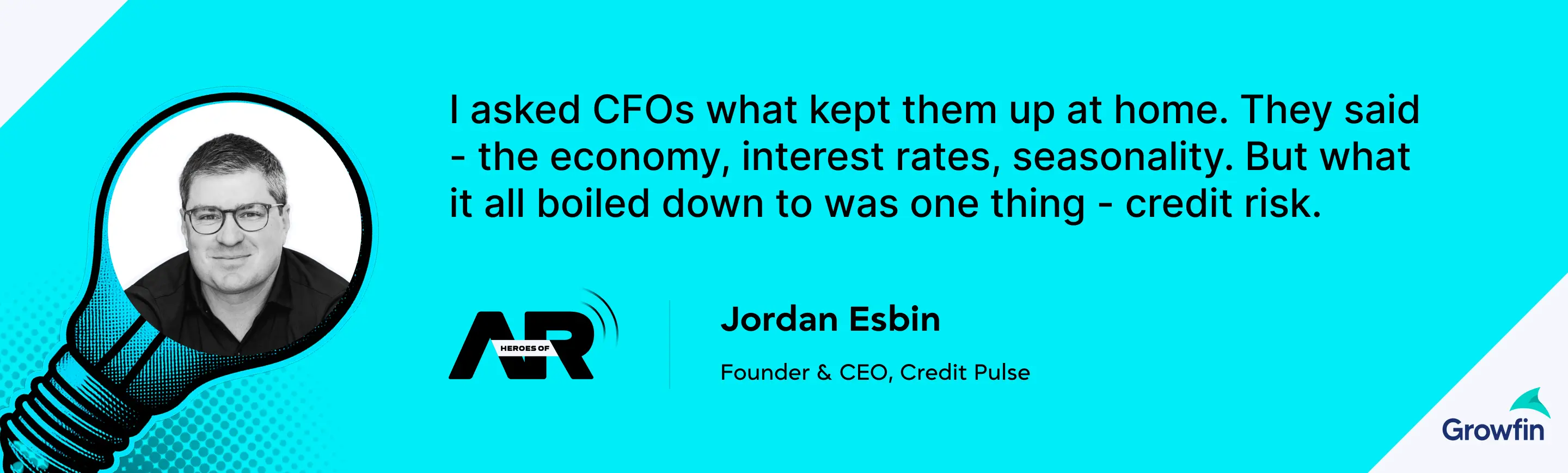
When I eventually decided to build a company, I went back to the same question I used to ask as a consultant: What keeps you up at night? I spoke with CFOs, and while they mentioned the economy, interest rates, and seasonality, it all boiled down to credit risk. When you look at a distributor or a manufacturer, especially wholesalers, they're essentially lending into their supply chain. They're a sales organization with a lending component.
Two things became clear. First, trade credit is an absolutely massive market that fintech has largely ignored. Second, almost everything in the credit process is still manual. Credit teams pull traditional credit reports - that's the one thing they can get at the click of a button. But everything after that - the application process, the research, the decision-making, portfolio reviews, follow-ups - it's all done by hand. I saw a huge opportunity to help these teams, and if we could do that, we could help make CFOs and their companies far more successful.
The Hidden Cost of Weak Credit Decisions
PH: What are the most common gaps or aftereffects of weak credit decisions? And on the flip side, what does healthy credit actually look like?
JE: There are a few telltale signs that weak decisions are being made. The most common one is when a credit manager is getting heavy pressure from sales or the executive team to approve accounts - and they don't have enough data to push back. They can't make a confident case for saying no or for recommending a lower credit limit. That's usually a process issue combined with an information gap.
The downstream consequences are serious. If you keep making poor credit decisions, or you extend too much credit to the CEO's friend, eventually you get burned. That means bad debt write-downs, difficult conversations with the CFO about how a risky account slipped through, and in the worst cases, a direct hit to working capital - you've shipped product and never been paid.
On the other end of the spectrum, healthy credit organizations have the right tools and data to make sound decisions. They have organizational alignment that empowers the credit team to say no - or set appropriate limits - even when a customer has personal ties to leadership. When you get that right, credit becomes a growth accelerator. Your risk profile is locked in, and you can pursue aggressive revenue growth with confidence. The best-performing companies I've worked with have generated hundreds of millions in additional annual revenue by treating credit as a growth-driving function.
TL;DR Weak credit decisions stem from insufficient data and process gaps, leading to bad debt and working capital losses. Healthy credit programs combine good data, sound processes, and organizational alignment - turning credit from a cost center into a revenue driver.
Bringing Credit and Collections Teams Together
PH: How do you think credit and collections teams could work together more effectively, including with other internal stakeholders, to make credit risk intelligence more valuable?
JE: We're seeing a clear trend, especially at larger companies, where credit and collections teams are being combined under a single leader - a Director of Order-to-Cash, a VP of Accounting, or a Chief Accounting Officer. But being on the same org chart doesn't necessarily mean they're collaborating well.
One of the most common symptoms of misalignment is that credit struggles to get a seat at the table in revenue and strategy discussions. It's often treated as a back-office function. I've heard people call it the "sales prevention department." But the reality is, credit and sales just have different incentives. Sales wants to grow revenue at almost any cost. Credit wants to protect the business at almost any cost. Neither is wrong, but they both tend to have blinders on.
The companies that get this right are the ones where credit and sales talk daily. It's a continuous conversation, not an occasional conflict. One thing that helps build that bridge is showing sales that credit data can actually help them make more money. When credit processes and intelligence support revenue growth, alignment becomes natural.
The rest comes down to expectations. Do finance, sales, customer support, and operations understand what the credit process looks like - and, more importantly, why it's structured that way? Getting that foundational understanding in place is how you build real cross-departmental alignment.
TL;DR Credit and collections teams are increasingly being merged organizationally, but true collaboration requires shared understanding and aligned incentives. The best-performing companies treat credit as a partner to sales, not a gatekeeper.
How Better Credit Processes Accelerate Sales
PH: You mentioned that getting credit right actually helps companies close more sales. Can you elaborate?
JE: There are two major growth opportunities tied to credit. The first is in the process itself. Most credit processes today are actually holding back sales - not because credit says no, but because the process is too slow. When you have paper or PDF applications, manual research, and manual decisioning, the whole cycle can take a week or longer. Meanwhile, the sales team is trying to close deals before quarter-end.
We help digitize the credit application, automate the research, and streamline the decision. What used to take weeks, we've brought down to minutes. That directly accelerates deal closure and creates a better customer experience from the very first interaction.
The second opportunity is in leveraging the data that credit teams are already sitting on. You have this massive portfolio of customers, but most teams don't have the tools to track how a customer's spend with your company compares to their spend elsewhere. Credit data can reveal whether you're losing share of wallet - and that's a golden insight for sales. If you know a customer is shifting spend away from you, you can proactively reach out, maybe increase their credit limit, and win that business back.
This is where we've seen customers unlock tens and even hundreds of millions in additional revenue - by speeding up the process and then mining the data for growth signals.
TL;DR Credit slows down sales not through rejections but through manual processes. Digitalizing the workflow compresses approval cycles from weeks to minutes. Beyond efficiency, credit portfolio data reveals share-of-wallet shifts that sales teams can act on to recapture revenue.
Where Growfin and Credit Pulse Come Together
PH: Growfin and Credit Pulse have recently partnered. How do you see the two platforms working together to deliver value?
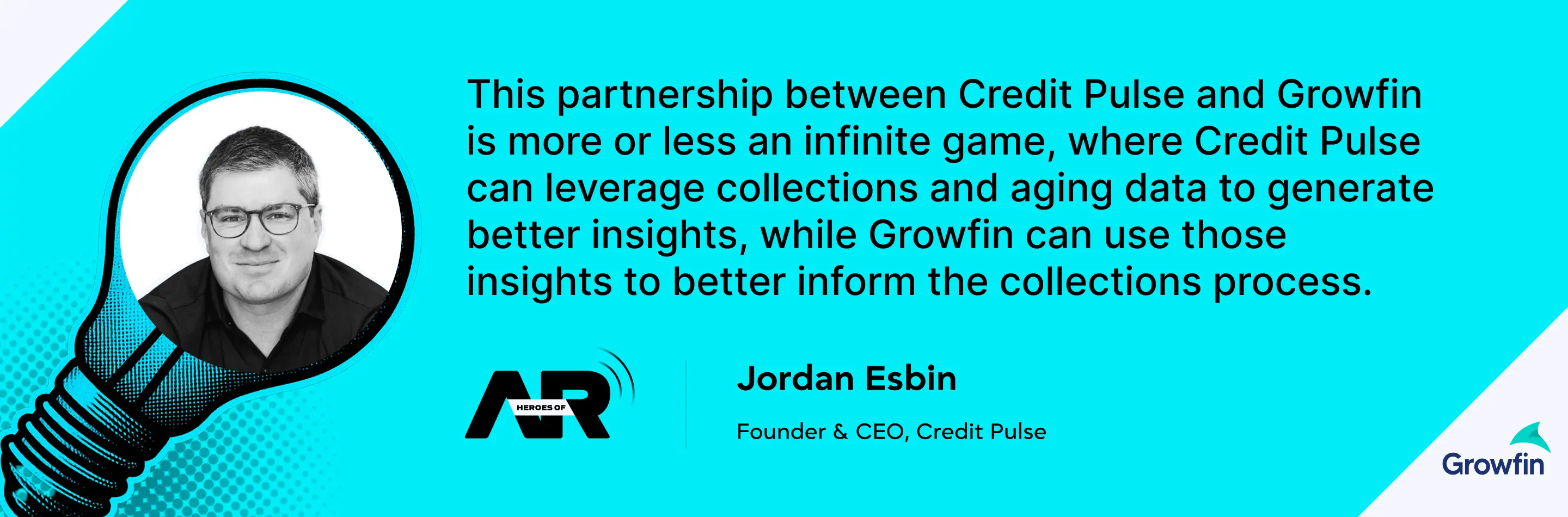
JE: The way I see this partnership is as an infinite game - there's so much we can do to help the market. The core idea is bringing credit and collections intelligence closer together. How can we leverage collections and aging data to produce better risk insights, and how can Growfin use those insights to improve the collections process? It creates a virtuous cycle of sharing data, generating insights, and taking action.
One example: we want to feed risk indicators directly into Growfin's collections module. Today, most AR teams prioritize work based on outstanding balance alone. But if a customer has a large balance and a very low risk of non-payment - because they always pay, just 15 days late - that shouldn't be at the top of the stack. Risk context helps collectors focus their time where it actually matters.
And where it gets really exciting is when this data starts feeding into Growfin's automated features, making dunning strategies and workflow triggers even smarter.
TL;DR The Growfin × Credit Pulse partnership creates a feedback loop between credit risk intelligence and collections execution - helping AR teams prioritize work smarter and automate follow-ups with better context.
Keeping AI Explainable and Trustworthy
PH: One concern that comes up often - how do you keep AI explainable enough that both AR and credit leaders can trust the outputs?
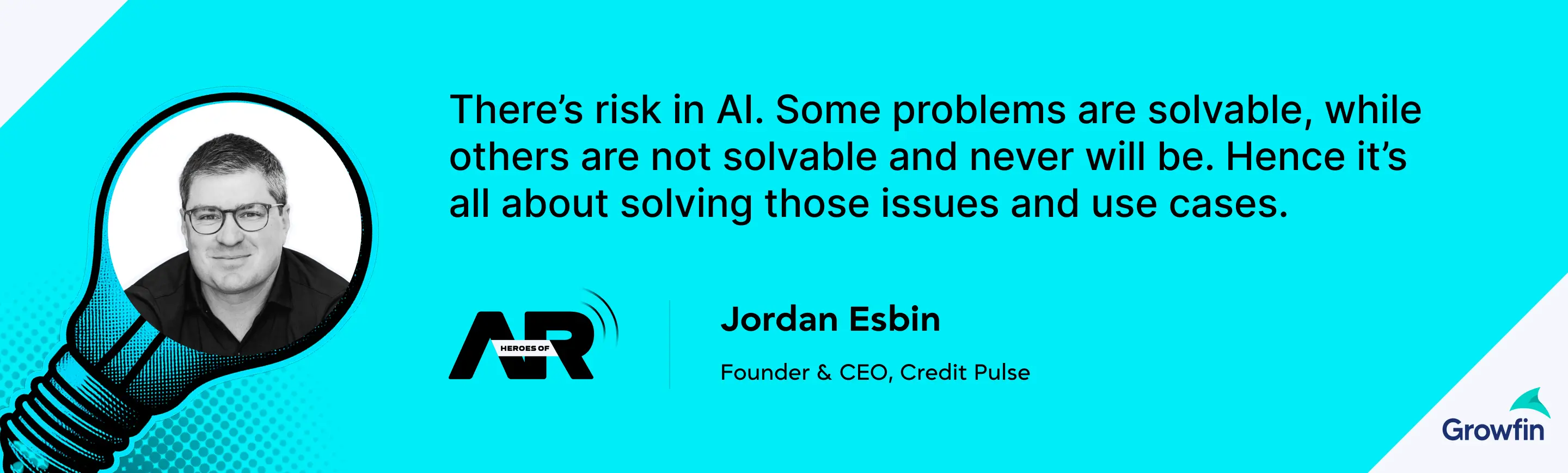
JE: There's risk in AI and we all know it. Some of the problems are solvable, some aren't - and it's all about how you manage that risk. We use a three-part framework.
First, use the right decision framework. Determine which use cases are genuinely suited for AI and which aren't. AI is excellent at language and context, but it's not great at math. Financial statement spreading or dense risk policy evaluation, for example - those are better handled deterministically. But AI can wrap those decisions with context, explaining why a particular recommendation was made. That's incredibly valuable. The key is: don't give AI the wrong problem to solve.
Second, invest in constant evaluation. There's a whole world of AI evals - testing, improving, and proving the model until it works reliably. Both Growfin and Credit Pulse are actively working on this.
Third, keep a human in the loop. This isn't a fallback - it should be part of almost every AI process. You still get efficiency from automation, but a human provides the quality assurance layer that keeps things on track.
TL;DR AI trust in credit and AR comes from three things: choosing the right use cases, continuously testing and evaluating the models, and maintaining human oversight as a standard part of every workflow.
A 90-Day Roadmap for AR Leaders
PH: If you were advising a senior AR leader who wants to leverage credit management data to improve their collections strategy, what would that roadmap look like over the next 90 days?
JE: The very best operators I've met in the credit space share a few common traits - and they're more personality-driven than process-driven.
The first is a constant hunger to improve. That starts with being clear about what's working and what isn't. Take an assembly-line approach: figure out where the biggest inefficiency, risk, or growth opportunity sits. But don't jump to solutions yet. Just diagnose the problem.
In your first 30 days, ask yourself: if I could wave a magic wand, what would this look like? Lower AR aging? Faster account approvals? Better customer experience? Insights that help sales close more? Pick the one or two problems that represent the biggest opportunity.
Next, leverage experts. Stand on the shoulders of giants. People in the credit space are incredibly generous with their insights and best practices. Build a playbook, then seek internal alignment - get your CFO, sales, operations, and finance teams on board with the outcome you're targeting.
And then when it comes to implementation, set expectations that this will take real work. Some of these projects can feel like eating an elephant, and you eat an elephant one bite at a time. Don't try to solve everything at once. Instead, find the earliest signal that you're on the right track and get to that inflection point as quickly as possible.
The order matters: people first, process second, technology third. Technology can make things dramatically easier, but I've seen teams sink millions into building custom AR or credit tools in-house and it rarely works. Your core competency isn't building software - it's running your business. That's where purpose-built platforms like Growfin and Credit Pulse deliver real ROI.
TL;DR Start by diagnosing the biggest problem (not jumping to solutions). Lean on industry experts to build a playbook. Align stakeholders around a clear outcome. Then implement in manageable steps - people, process, and technology, in that order.
Final Takeaways
- Credit risk is a revenue lever, not just a safety net. When credit teams have the right data and processes, they can lock in the organization's risk profile - freeing up the business to pursue aggressive growth with confidence.
- Organizational alignment between credit and sales is non-negotiable. The most effective teams treat credit as a growth partner, not a back-office blocker. Daily communication and shared incentives make the difference.
- Speed is a competitive advantage. Manual credit processes slow down deal closure. Automating the application-to-decision cycle from weeks to minutes directly accelerates revenue.
- Credit data is an untapped growth signal. Tracking share-of-wallet shifts across your customer portfolio reveals opportunities that sales teams can act on immediately.
- AI needs the right use case, constant testing, and human oversight. Don't deploy AI just because it's new. Solve real problems, evaluate rigorously, and keep humans in the loop.
- Start with people, then process, then technology. The best 90-day roadmap begins with problem diagnosis and stakeholder alignment - technology comes last, but makes everything easier when the foundation is right.
Check out Growfin's collections and cash application solution, and start building your AI-driven AR processes.


.webp)
.webp)

.webp)
.webp)