

.png)
.webp)


.webp)


.webp)



Ask most finance teams how AR is doing and you get one number back: did we collect?
Vasudha Sharma has spent 7 years showing that number hides more than it reveals. Across HCLTech and Accenture, she moved from execution-focused AR work into end-to-end order-to-cash ownership covering collections, cash application, reconciliation, and working capital insight. Along the way, the aging report became something she reads like a diagnostic on business health.
In this episode of Heroes of AR, host Ashish Cherian (Product Marketing Manager, Growfin) sits down with her to unpack what that shift looks like in practice: why the same AR problems keep repeating, how upstream decisions in sales and billing surface as disputes months later, and where agentic AI earns its place in the workflow.
Below is their conversation, in a question and answer format.
How has the role of accounts receivable changed over the past seven years?
AR has shifted from a task-completion function into a business decision function. Early AR careers focus on posting cash, clearing invoices, and meeting SLAs. Ownership changes that lens completely.
When I started my career, AR felt very process-oriented. My focus was completing tasks correctly, posting cash, reconciling accounts, meeting SLAs. Over the years, especially when I started handling responsibilities end to end, I realized AR is one of the biggest indicators of how healthy a business is operationally.
The turning point, she explains, is accountability. Once you own the outcome instead of the activity, the question changes from "how do I complete this" to "why does this keep happening, and what is it doing to cash flow and customer relationships." Delayed approvals, recurring unapplied cash, weak dispute ownership, and shifting customer behavior all become readable signals rather than isolated tickets.
Why do the same AR problems keep repeating across companies and industries?
Because most organizations fix the symptom and leave the root cause untouched. The friction points in AR, including disputes, broken workflows, and reconciliation gaps, are usually structural rather than operational.
Vasudha's view is that billing and dispute errors do the most long-term damage, because a wrong invoice distorts the entire downstream cycle.
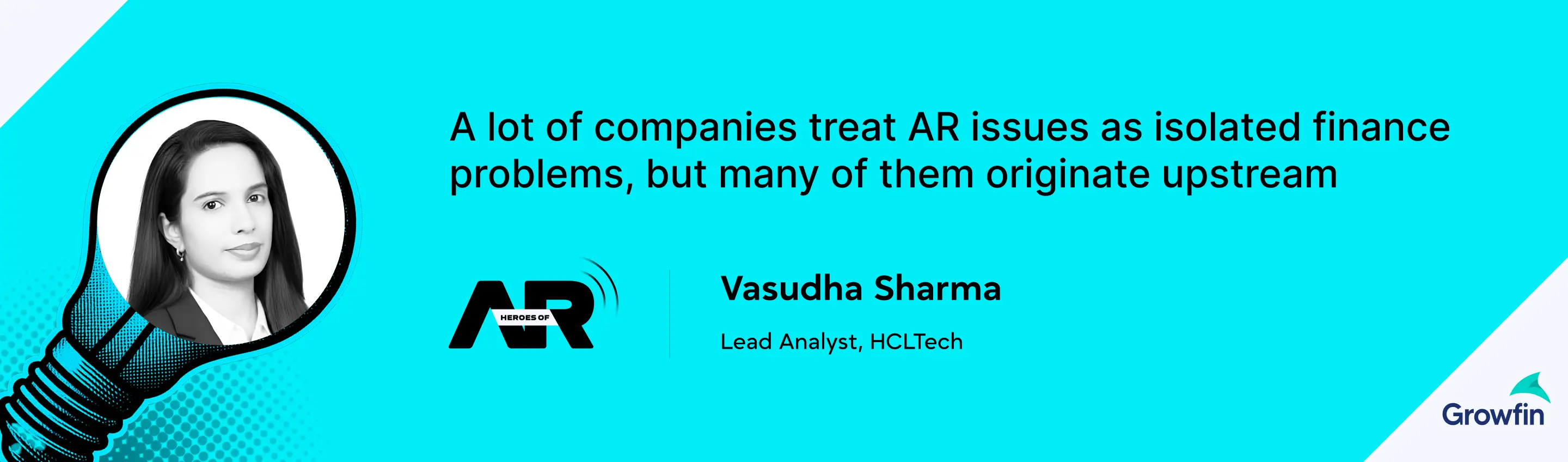
She points to fragmented ownership as the reason the cycle never ends. When no single team owns the problem, everyone assumes someone else will fix it, delays become normal, and inefficiency becomes part of the process. Her conclusion: strong collaboration and process visibility are what keep AR stable over the long run.
Why is cash application one of the most underrated functions in AR?
Because it stays invisible when it works and distorts everything when it breaks. Cash application directly shapes how accurately a business understands its cash position and receivables health, yet many teams still treat it as back-office reconciliation.
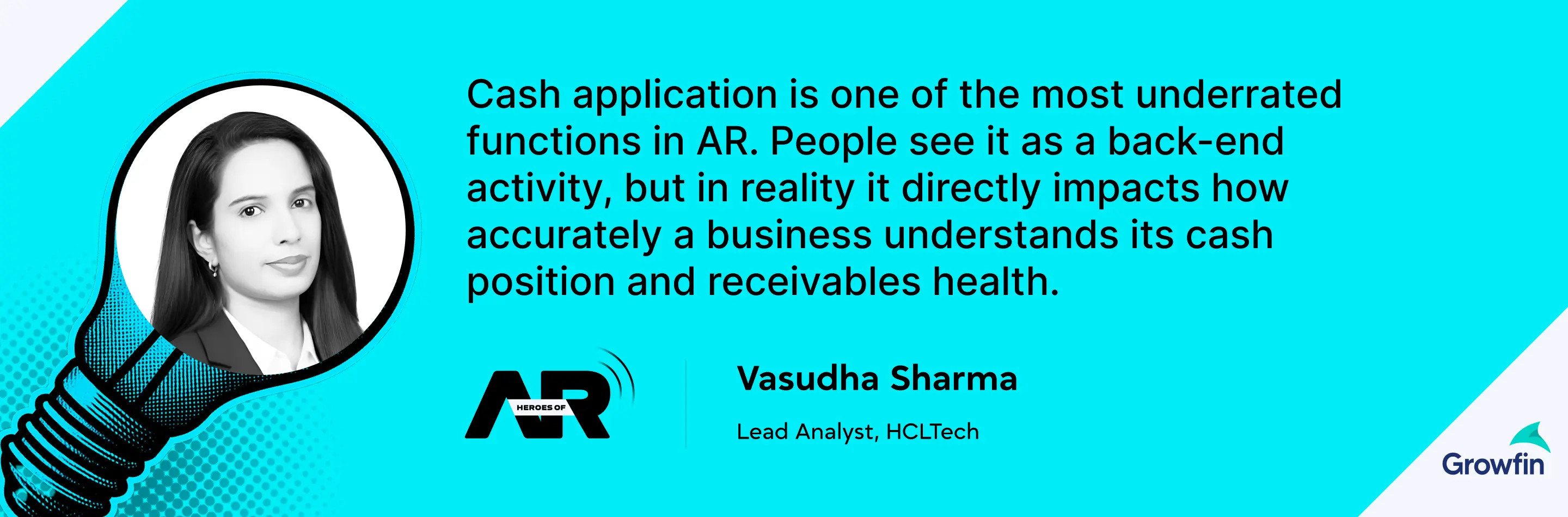
The common failure pattern she sees is heavy reliance on manual intervention, especially when remittance details are unclear or short payments arrive in high volume. Small application delays compound into large unapplied cash balances over time.
A well-functioning cash application process creates a ripple effect: cleaner reporting, faster reconciliation, fewer disputes, and better leadership visibility into real cash flow. It also frees AR teams to do strategic work instead of constantly cleaning data and correcting mismatches.
Where do the biggest disconnects between AR and upstream teams happen?
The widest gap sits between sales commitments and operational execution. Deals close fast to hit targets, but pricing structures, approval conditions, and service expectations are not aligned across teams. AR then inherits incomplete information and absorbs the fallout.
Sometimes deals get closed quickly to meet business targets, but billing, pricing structures, approval conditions, or service expectations are not clearly aligned across teams. AR receives incomplete or inconsistent information, and that shows up as billing errors, disputes, or delayed payments.
Contract management is a second fault line. Revised pricing, milestone billing, credit notes, or changed payment terms create major downstream issues when they are not reflected correctly in the ERP or billing system. Customers catch the discrepancy immediately, the invoice goes to dispute, and collections stall.
The deeper problem is fragmented ownership. Sales assumes finance will handle it later, operations assumes billing has the right information, and AR becomes the final team trying to stabilize cash flow. These issues rarely arrive as one big event. They build gradually through recurring disputes, aging growth, and eroding customer confidence in invoice accuracy.
Why is system integration so critical to AR performance, and what breaks first?
The first thing to break is visibility and trust in the data. AR sits at the intersection of CRM, billing, banking, and ERP systems, so a single sync gap creates operational confusion quickly.
What usually breaks first is visibility and trust in data. Teams start relying on manual trackers, multiple Excel files, and email follow-ups just to validate information. That increases delays, duplicate effort, reconciliation gaps, and dependency on individuals instead of processes.
When contract terms in the CRM do not sync to billing, invoices go out with wrong pricing. When payment data lags between systems, cash application and aging reports drift out of accuracy. When communication tools sit outside the workflow, teams lose sight of approvals and dispute decisions.
A well-integrated landscape behaves differently. Information moves cleanly across teams, invoice and payment data stays consistent, and AR spends less time stitching context together by hand. Integrations with communication platforms like Outlook, Gmail, and Slack matter here too, because modern AR runs on timely collaboration as much as on transactions.
This is why platforms like Growfin invest in deeper connections across ERP, CRM, and communication systems. AR cannot operate in silos.
Where does agentic AI create the most practical value in AR and O2C?
The highest-value use is context-aware prioritization, but the entry condition is data security. Vasudha is direct that security comes first for any organization adopting AI agents, and that complexity has grown because companies now run many billing models at once.
Earlier, invoicing was comparatively straightforward. Now companies handle subscriptions, one-time invoices, milestones, renewals, usage-based pricing, credits, and regional variations at the same time. Each model behaves differently from an AR perspective.
Subscriptions need recurring billing accuracy and renewal tracking. Service models depend on project completion and approvals. Usage-based pricing depends on real-time data accuracy. The more monetization models a company adds, the more dependency it creates between systems, operations, and customer communication. That complexity is exactly where agentic AI earns its place: understanding context, deciding who to prioritize, and acting on the right workflows instead of running blind rule-based reminders.
Vasudha is equally clear that this does not remove people from the process.
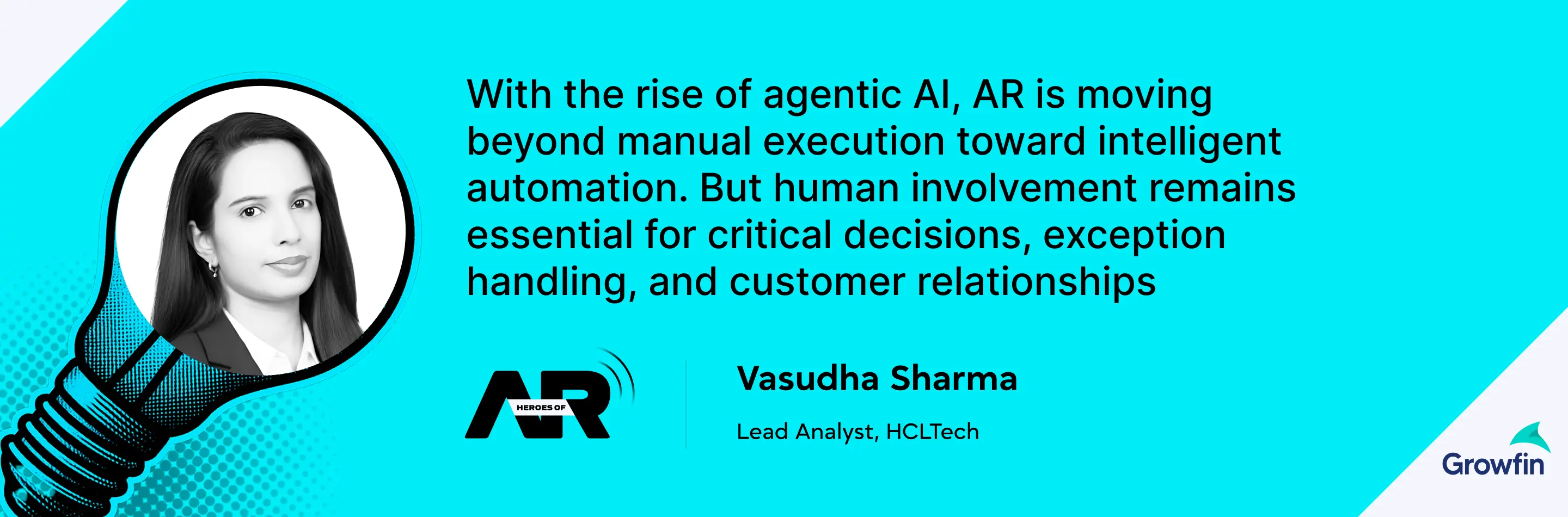
The practical takeaway for leaders evaluating ROI: agents handle the high-volume, context-heavy follow-up and matching work, while humans stay in the loop for judgment calls. The fear that AI removes the human is the main thing keeping teams stuck in pilots they never scale.
What is the final advice for AR teams stuck in manual, reactive processes?
Fix the upstream, not just the symptom. Vasudha's strongest learning across 7 years is that most AR challenges start before AR ever sees them.
One of the strongest learnings for me is that many AR challenges originate upstream, through sales decisions, contract structures, billing accuracy, or weak system integrations. They later appear as disputes, delayed collections, unapplied cash, or unreliable reporting. That's why collaboration across teams and integration between ERP, CRM, billing, and communication tools has become essential.
The AR function is moving from execution to orchestration. The teams that win treat receivables as a visibility layer into business health, invest in cross-functional alignment, and use AI to remove the manual chunk so people can focus on decisions.
TL;DR: key takeaways
- AR has evolved from a task function into a business decision function. The aging report reads as business health, not just unpaid invoices.
- Most AR problems originate upstream in sales, contracts, and billing, then surface later as disputes, short payments, and unapplied cash.
- Cash application is the most underrated AR function. When it breaks, forecasting, reporting, and collections all distort.
- Visibility and trust in data break first when systems are not integrated. AR then runs on Excel trackers and manual validation.
- Agentic AI adds the most value in context-aware prioritization, with humans kept in the loop for judgment and exceptions.
See how Growfin connects your AR workflows
Growfin automates cash application and collections on top of deep ERP, CRM, and communication integrations, so your team works from one source of truth instead of stitching context across systems. Book a demo to see it on your own receivables data.


.webp)
.webp)

.webp)
.webp)