

.png)
.webp)


.webp)


.webp)


.webp)
59% of finance leaders have reported using AI in their finance function, according to Gartner. The pressure behind it is specific: collect faster, forecast accurately, scale without adding headcount. Deloitte reports 84% of CFOs expect rising cost pressures over the next year. AR teams absorb most of that pressure.
Most of the investment has gone towards AI but the industry is now extending towards Agentic AI.
These are systems that act on data: matching payments, adjusting dunning strategies, flagging risk, and executing follow-ups based on live signals, all while keeping a human in the loop for exceptions.
This piece covers 5 agentic AI use cases running in production across accounts receivable today.
What agentic AI means in a finance context
Agentic AI refers to AI systems that take autonomous action within defined guardrails. They learn from outcomes and adjust behavior over time. In accounts receivable, this means AI that executes tasks: sending follow-ups, matching payments, adjusting credit limits, escalating exceptions. Humans retain oversight for edge cases and strategic decisions.
The distinction from traditional automation matters. A rule-based system sends a dunning email on Day 7 regardless of context. An agentic system evaluates the customer's payment history, open disputes, and engagement patterns, then decides whether Day 7 is the right moment or whether a different action will collect faster. We've seen this distinction account for 20 to 30 percentage points in collection effectiveness across our customer base.
Use case 1: Continuous credit risk monitoring
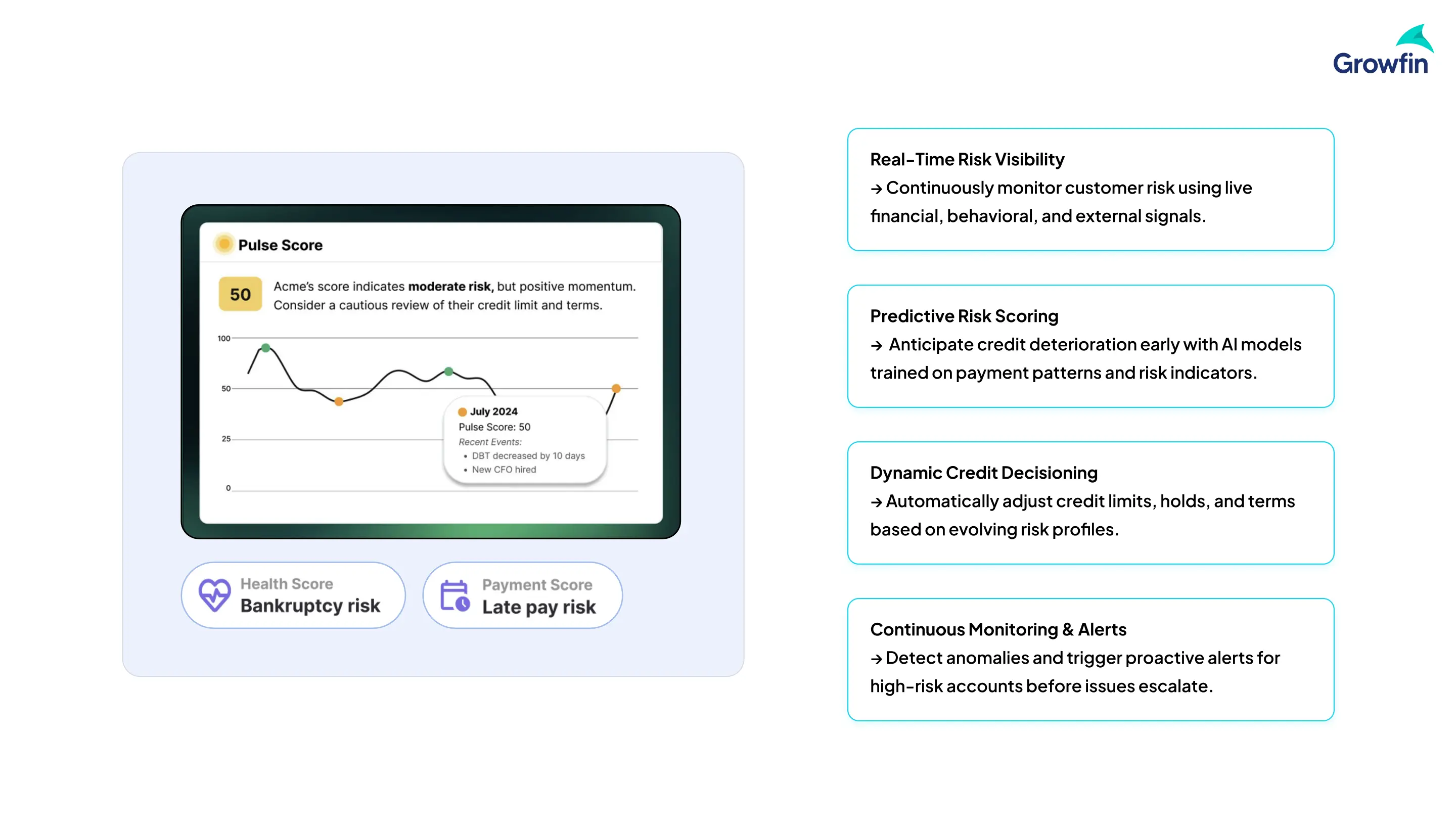
Quarterly credit reviews miss signals that move faster than the review cycle. By the time a portfolio review flags deterioration, the damage is already in the aging report.
Agentic AI replaces periodic reviews with continuous monitoring. Growfin's approach uses a Pulse Score that ingests live financial, behavioral, and external signals to generate a dynamic risk score for every customer. When a score shifts (payment timing changes, a dispute pattern emerges, external credit data deteriorates), the system triggers alerts or automatically adjusts credit limits and terms.
This matters for AR teams because credit decisions and collection outcomes are connected. A customer approved at a limit that no longer reflects their risk profile creates downstream collection problems. Continuous monitoring catches the drift before it shows up in aging.
Use case 2: Dynamic health scoring and intelligent dunning
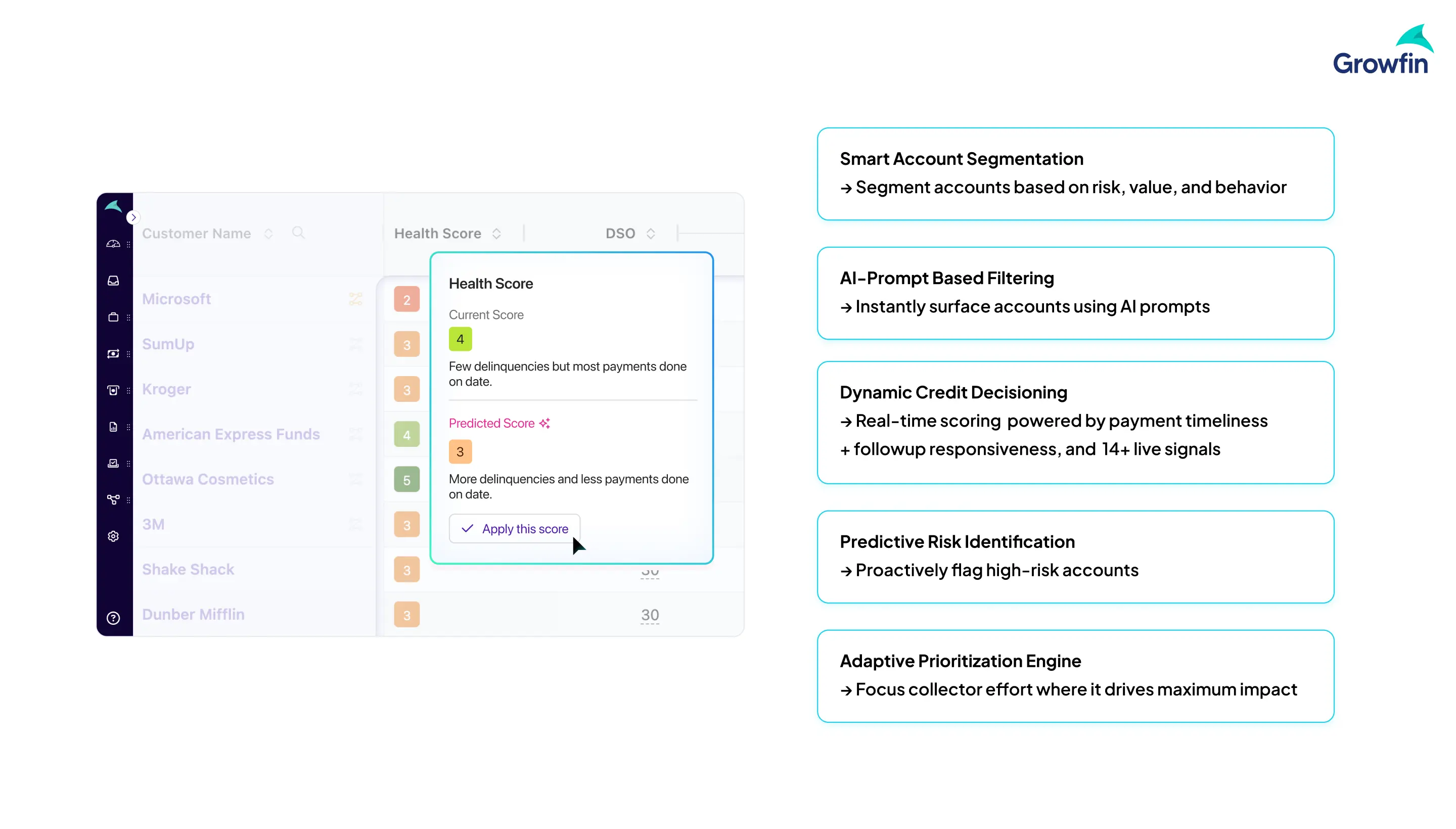
Collections teams typically segment accounts by aging bucket or dollar amount. Both are backward-looking. A $500K account in the 30-day bucket might be perfectly safe (they always pay on Day 28) or a serious risk (they just raised 3 disputes and stopped responding to emails). Static segmentation can't tell the difference.
Growfin scores accounts using 14+ live signals: payment timeliness, follow-up responsiveness, dispute frequency, promise-to-pay history, and engagement patterns. The health score drives dunning strategy in real time. High-risk accounts get escalated. Reliable late payers get a lighter touch. Accounts showing early stress get intervention before they age into the 60-day bucket.
Air Comm reduced DSO by 33% after implementing AI-driven prioritization and dynamic dunning, focusing collector effort where it had the highest impact on cash recovery.
Use case 3: Conversational AR inbox
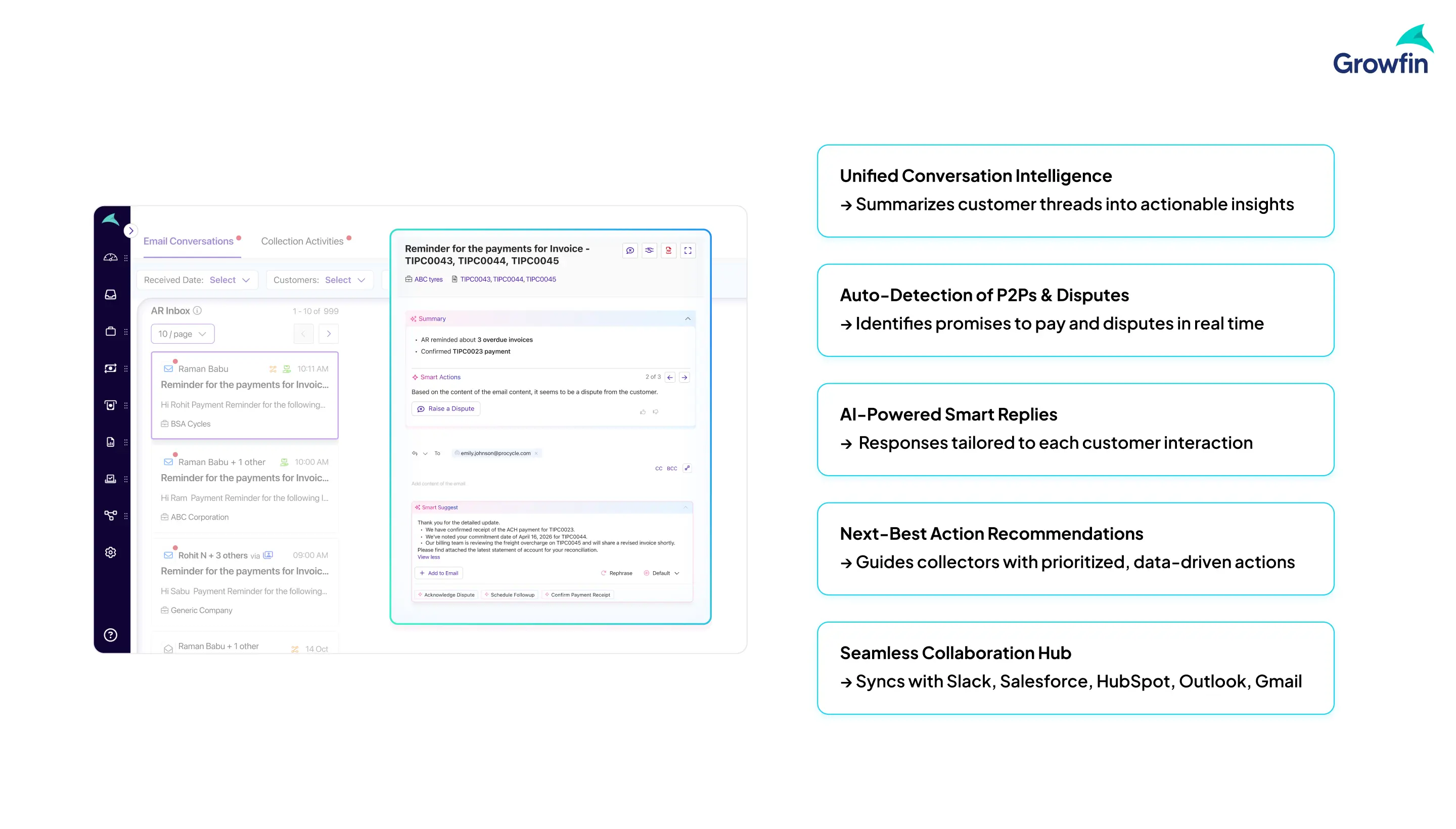
80% of collectors' time goes to email. Most of that time is spent reading threads, identifying whether a customer made a promise to pay, flagged a dispute, or asked a question, then deciding what to do next.
Growfin's AR inbox changes the workflow. The system summarizes customer threads into structured insights, auto-detects promises to pay and disputes as they come in, drafts context-aware replies, and recommends the next-best action based on the account's full history. Collectors open a prioritized queue with recommended actions.
The system syncs with CRM, ERP, and communication tools (Slack, Outlook, Gmail), so collection activity and customer context live in one place. We've found the biggest time savings come from automated P2P and dispute detection, which eliminates the manual classification step that eats 15 to 20 minutes per account per day for active collectors.
Use case 4: Autonomous collection agents
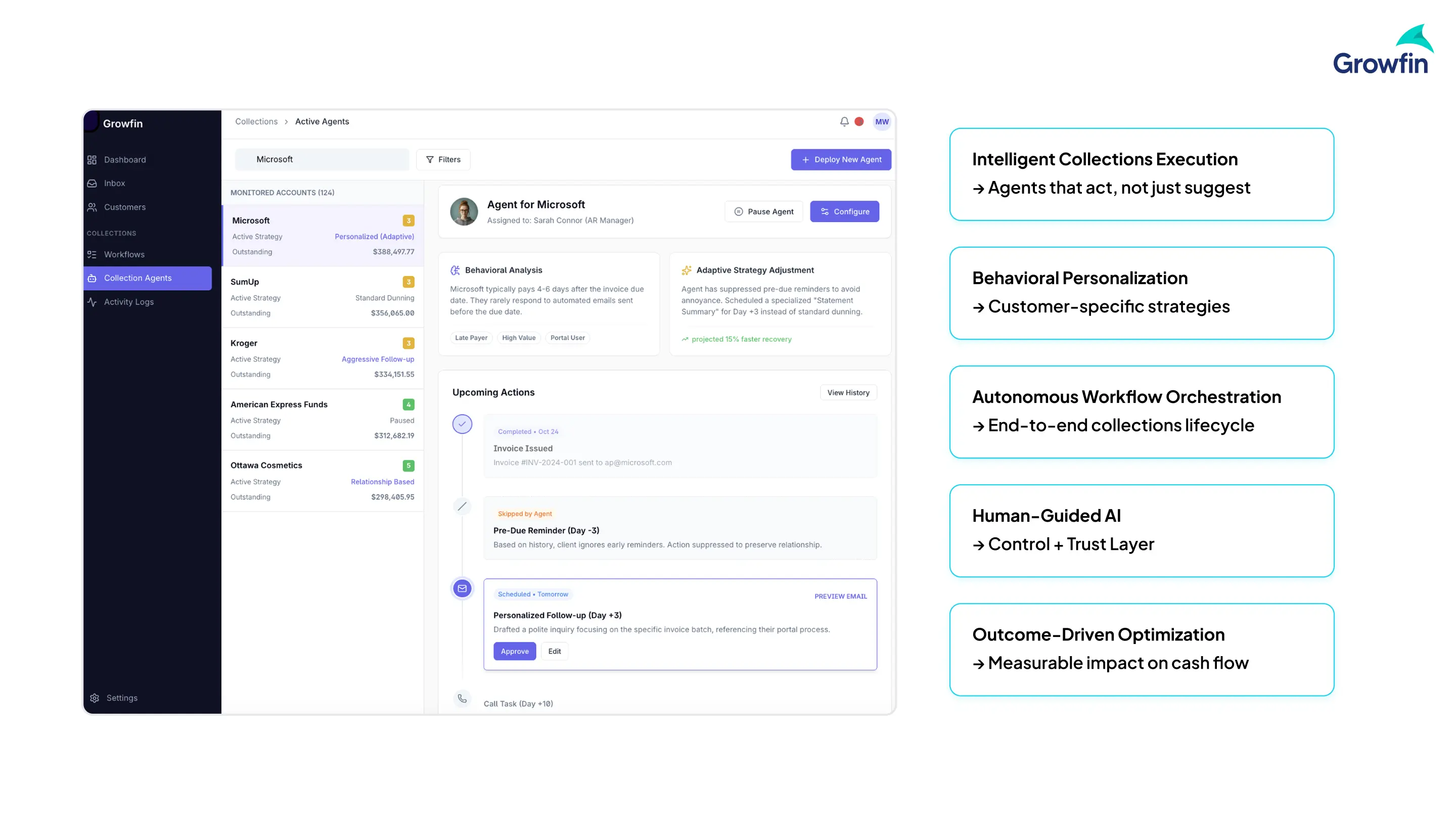
An autonomous collection agent manages the end-to-end collections lifecycle for assigned accounts. It sends follow-ups, adjusts strategy based on customer response patterns, suppresses actions that won't work (skipping pre-due reminders for a customer who never responds to them), and escalates to a human when the situation needs judgment.
Growfin's Collection Agent operates within policies set by the AR team. Managers can pause, override, or reconfigure the agent at any point. The system explains its reasoning for every action: why it chose this email, why it suppressed that reminder, why it escalated. The team maintains full control and an auditable decision trail.
Greenhouse automated 65% of collection tasks using this approach. Kelly-Anne Kratz, Senior AR Manager at Greenhouse, noted that segmented accounts and tailored dunning strategies became possible because Growfin connected cleanly to their ERP (NetSuite).
Use case 5: Cash application AI
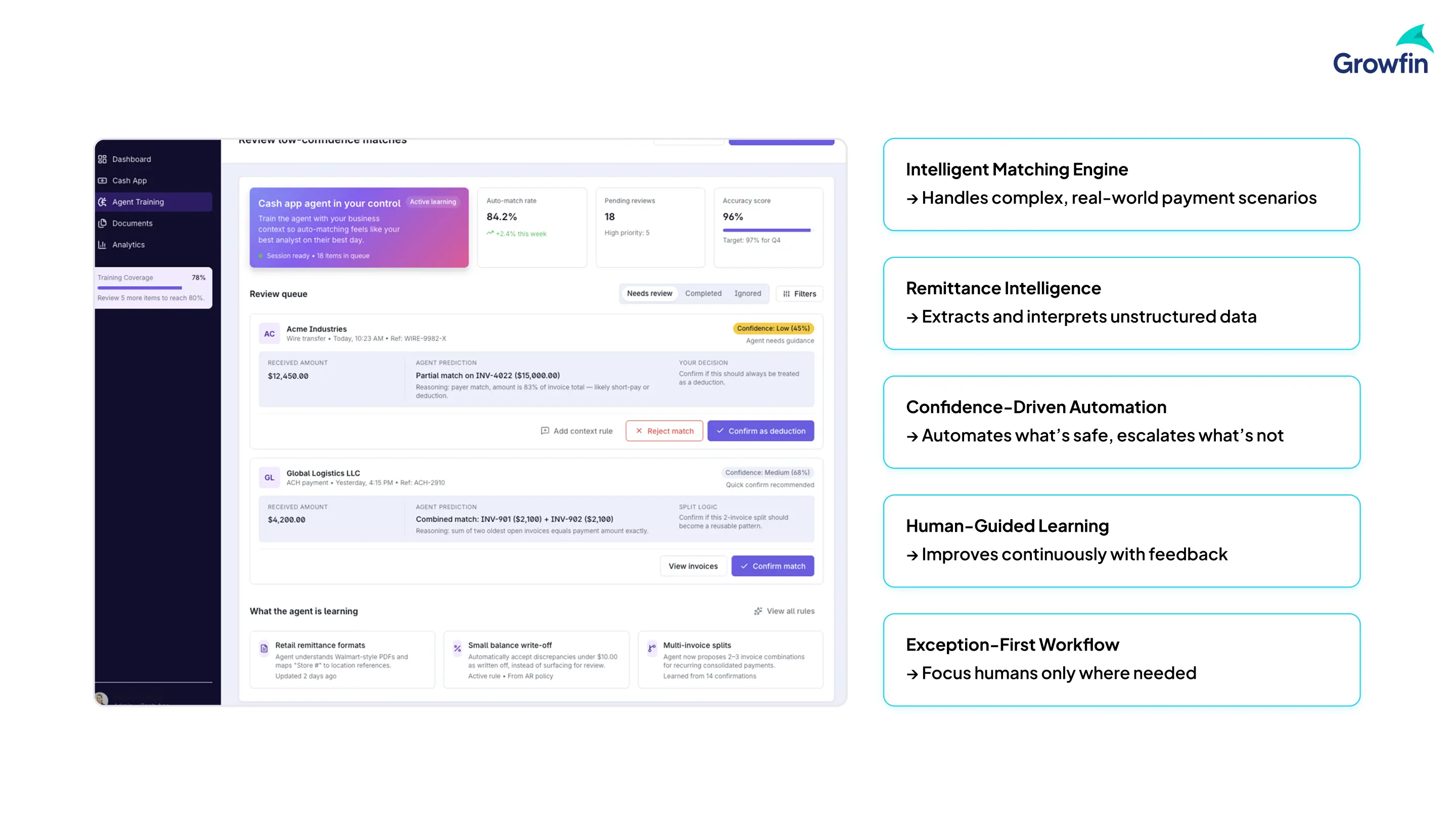
Cash application is the most AI-mature function in accounts receivable. Forrester reports AI has enabled up to 90% reduction in manual cash application effort.
Growfin's SmartMatch AI parses remittance data across formats and channels (ACH, wire, check, lockbox), matches payments to open invoices, and assigns a confidence score to each match. High-confidence matches post automatically. Low-confidence matches route to a human review queue with the agent's reasoning and recommended action.
The system learns from every human decision. When an analyst confirms or rejects a match, that feedback trains the model. Teams running SmartMatch consistently reach 95%+ straight-through processing rates, with 97%+ accuracy on matched payments. Same-day ERP sync removes the reconciliation bottleneck that delays financial close.
What these 5 use cases signal
These use cases share a pattern. Each one takes a process that ran on human judgment for routine decisions and shifts that judgment to a system that learns and adapts. Humans stay focused on exceptions and strategy.
The operational impact compounds. Faster cash application means cleaner aging. Better dunning means lower DSO. Continuous risk monitoring means fewer surprises. When these systems run together across the receivables lifecycle, the combined effect is larger than any single use case delivers alone.
The teams seeing these results started with one use case, proved the value, and expanded. The practical starting point for most AR teams is the process where data quality is highest and the workload is most repetitive: typically cash application or dunning automation.
See how Growfin's agentic AI works across accounts receivable. Book a demo.
TL;DR
Five agentic AI use cases are live in accounts receivable today: continuous credit risk monitoring, dynamic health scoring for dunning, conversational AR inbox, autonomous collection agents, and cash application AI with confidence-driven matching. Each replaces a manual, reactive process with a system that acts on live signals and learns from outcomes. The practical starting point is the process with the highest data quality and most repetitive workload.


.webp)
.webp)

.webp)
.webp)