

.png)
.webp)


.webp)


.webp)


.png)
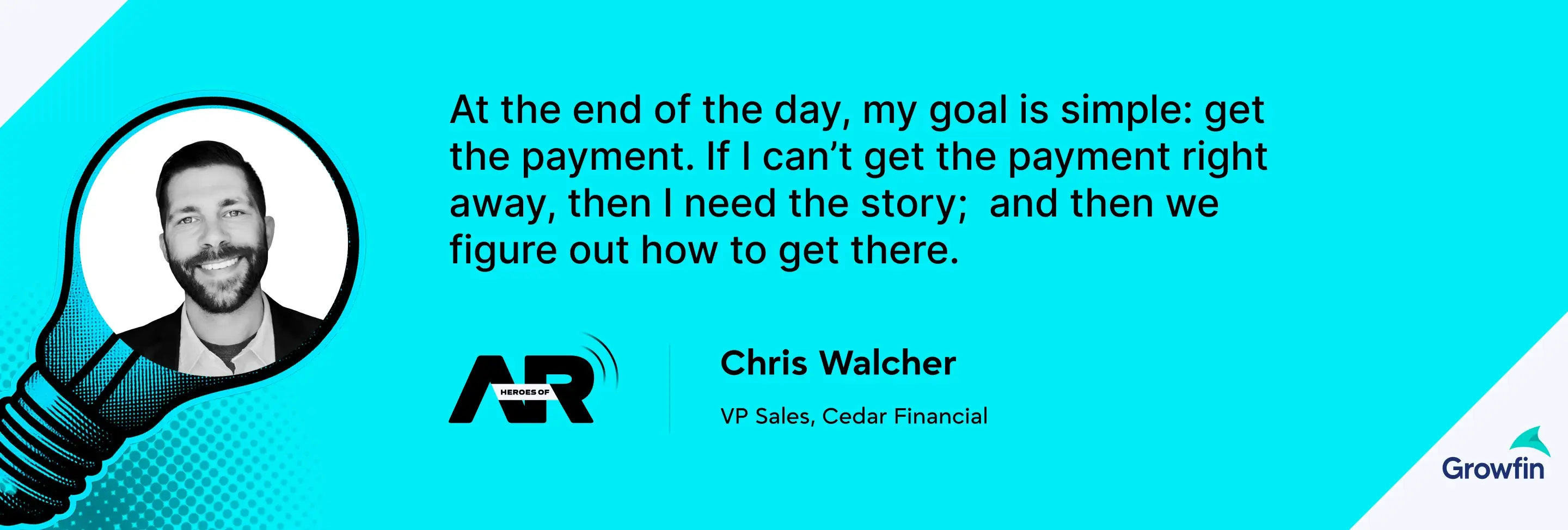
From pre-delinquency reminders to AI-driven collections workflows, accounts receivable today sits in a far more complex place than it once did. In this episode of Heroes of AR, Pradyut Hande, Head of Product Marketing at Growfin sits down with Chris Walcher, VP of Sales at Cedar Financial, to unpack what actually changes and what stays the same when collecting across B2B and B2C. The conversation explores proactive outreach, customer communication, behavioral data, and why human involvement remains critical even as automation scales.
PH: Before we get into the nuances, can you tell us a little bit about what you do at Cedar Financial and how your work spans both B2B and B2C?
CW: I’m the Vice President of Sales at Cedar Financial. For anyone who may not be familiar, Cedar is a global accounts receivable management firm. What that really means is we support clients across the entire lifecycle. We work on the first-party side with billing and invoicing before anything becomes delinquent. We support early intervention in that 30-, 60-, and 90-day window. And then we’re also a nationally licensed third-party debt recovery firm.
We operate in more than 170 countries worldwide. On a day-to-day basis, that means we’re working across very different environments. On the B2B side, that could be manufacturing or SaaS. On the B2C side, it could be retail, e-commerce, healthcare, or higher education. The biggest difference is sensitivity and regulation. When you’re dealing with B2C, the regulatory expectations are much higher. That impacts how you communicate, how often you reach out, and how you think about the overall experience.
What excites me about this conversation is not just how you sell or land a portfolio, but what actually happens once it’s live: how production works, how operations work, and how you get the best results from the inventory you’re managing.
What Should Happen Before an Account Becomes Delinquent
PH: What do you think should definitely happen before an account becomes delinquent? Is there a pre-delinquency playbook for both B2B and B2C?
CW: The biggest mistake I see creditors make before an account goes delinquent is a lack of proactivity. We talk a lot today about omnichannel and digital omnichannel communication, but what does that actually mean? To me, it means using every communication channel available to you: phone calls, emails, text messages, internal portals, and mobile applications. There should be a clear ramp-up in communication for at least 30 days before delinquency.
One of my favorite examples is a simple B2C one: my utility bill. I get a text message five days before my bill is due. I already know when it’s due, but if something goes wrong with auto-pay or ACH, that reminder gives me time to react. That small effort goes a long way and reduces delinquency.
The best advice I can give is to reach customers across channels while also paying attention to their preferences. For example, in healthcare, older patients may not respond to texts or emails. Younger customers like me might not check email often, but we’ll read a text.
TL;DR
Chris stresses that proactive, multi-channel communication before delinquency based on how customers actually respond prevents avoidable payment failures.
Early Delinquency, Tone, and Personalization
PH: Once a customer is in the early stages of delinquency, how should outreach change?
CW: The way you show that you actually care about resolution is through personalization and tone. There’s a big difference between getting a message that says, “You’re five days late, and if you don’t pay in 20 days this will happen,” versus a message that says, “Hey, I noticed you missed a payment — is everything okay?” The first one is aggressive. The second one makes you an ally instead of an aggressor.
If someone asks me whether everything is okay, I’m much more likely to open up. That’s usually when people explain what’s going on; maybe they lost a job or things are tight that week. At that point, it’s on the creditor to have some flexibility. That’s when you can talk about partial payments or short deferments that actually work for both sides. One of the biggest missteps I see is the one-size-fits-all approach. If you don’t pay this amount on this day, you’re done. We’re living in a time of very high consumer debt.
I come from a sales background, so I think a lot about lifetime value. Letting a small payment issue ruin a long-term relationship just isn’t good business. It costs a lot more to bring on a new customer than to keep an existing one.
TL;DR
Tone matters. Supportive, personalized outreach in early delinquency leads to more engagement, more honesty, and better payment outcomes.
Behavioral Data and Propensity to Pay
PH: What behavioral elements should AR teams look at to make automation and AI effective?
CW: Agencies have used propensity-to-pay models for a long time. What’s changed is that AI allows us to analyze millions of data points instead of just a few. You’re looking at things like location, age, payment history, financial health, credit signals, and the nature of the obligation itself. At Cedar, we use historical data to understand what worked and what didn’t. The first thing we want to know is the probability of repayment.
In the first 30 days, I want to place accounts into one of four categories:
- Willing and able to pay
- Willing but unable due to hardship
- Unwilling but able, usually a dispute
- Unwilling and unable, where settlements may make sense
That helps us prioritize. High-probability accounts become quick wins, and that frees up time to handle more complex situations properly. Most people aren’t calling in just to avoid paying. A lot of disputes come from something that went wrong earlier, and the creditor may not even be aware of it. Our job is to understand the story and then figure out what comes next.
At the same time, the biggest change is that these models are no longer static. Propensity to pay changes all the time. It’s affected by aspects like the financial health, assets, credit activity, seasonality, and more. For example, during the holidays, people tend to spend more and payment probability drops. In the same manner, during tax season, it increases. Therefore, it’s not a set-it-and-forget-it score; but a model that needs to run continuously to stay accurate.
TL;DR
Propensity-to-pay models help AR teams prioritize accounts, personalize outreach, and focus human effort where it matters most. Modern propensity models are dynamic and need constant updating to reflect real-world conditions.
Non-Negotiables in AR
PH: What are the non-negotiables AR teams need to get right when adopting AI?
CW: First, make sure you’re solving a real problem. Don’t add AI just because it’s new.
Second, your compliance guardrails need to be locked in before anything goes live. Especially in B2C, regulations around outreach frequency, disclosures, and personal data are non-negotiable.
Third, AI needs ongoing monitoring. There are companies today with full-time roles focused on reviewing AI interactions. The last thing you want is a system hallucinating or saying something that puts your organization at risk.
TL;DR
AI works when it solves a real problem, operates within strict compliance rules, and is actively monitored by humans.
Human-in-the-Loop and Customer Journey
PH: Where should humans stay involved in AI-enabled collections?
CW: AI works really well for straightforward payments. But when someone wants to tell their story — whether it’s hardship or a dispute — that’s where a human handoff is essential. That handoff needs to feel seamless. Humans should focus on complex conversations, while automation handles the administrative work.
Customer journey is critical here. If an AI offers a discount or settlement, that information needs to carry through across channels. Nothing frustrates someone faster than being told one thing and seeing something different when they try to pay.
TL;DR
Automation should handle simple tasks, while humans handle complexity, empathy, and judgment — with smooth handoffs between the two.
Final Takeaways
- Being proactive matters more than being loud later
Most delinquency issues start small. Reaching out early — before or right as a payment is missed — gives customers a chance to fix issues like failed auto-payments before things escalate. - How you say it can matter more than what you say
Early outreach that feels aggressive often shuts conversations down. A simple, supportive check-in makes it easier for customers to respond, explain what’s going on, and stay engaged. - Not every account needs the same approach
Behavioral data and propensity models help teams decide where to focus first. Some accounts just need a nudge, while others need time, flexibility, or a real conversation. - A customer’s ability to pay isn’t fixed
Payment behavior changes with context — financial health, timing, and even the time of year. Any model or strategy needs to account for that reality rather than treating payment risk as static. - Automation only works when the rules are clear
AI can help scale collections, but only if compliance is built in from the start. Guardrails, monitoring, and oversight are what make automation usable in the real world. - Some conversations still need a human
When payments involve hardship or disputes, people want to be heard. Automation can handle the basics, but human judgment is still what moves complex situations forward.
Check out Growfin’s collections and cash applications solution, and start building your AI-driven AR processes.


.webp)
.webp)

.webp)
.webp)