

.png)
.webp)


.webp)


.webp)



You already know that the Accounts Receivable (AR) inbox is inefficient. But; let’s view this more objectively. Your AR inbox is the only operational surface in finance where judgment, communication, and decision-making happen inside a system with no underlying design.
That’s why; while every other part of finance runs on rules, thresholds, workflow gates, authorizations, and auditability, inbox-driven AR runs on something else: the assumption that judgement will eventually find its way to the right person at the right time.
That assumption held when volumes were small, customer behavior was predictable, and business models were simpler. However, under modern AR complexity, it collapses.
For example: Consider a global B2B firm with multiple ERPs, shared inboxes, and a 45-day DSO. In one quarter, a cluster of disputes from the top 10 customers went un-escalated for 18 days because there was no owner or SLA. The CFO gets incorrect insights, and nobody can reconstruct what happened.
The inbox did not create these conditions, but; it guarantees leaders can’t correct them.
Hence, this blog is not another critique of the email. Instead, it’s a blueprint from something leaders have not been offered before, for where human judgement belongs inside an intelligent AR workflow, and how designed checkpoints could restore control, predictability, and credibility.
Atradius’ latest data highlights the scale of the problem:
- 50% all B2B invoices in the US are overdue
- Overdue invoices convert to cash 20 days past due, on average
- Bad debts sit at 8% of credit sales
The Failure Modes of Inbox-based AR
Even with great collectors, the current inbox-led AR guarantees four modes of structural failures:
Failure 1: Delays hide inside threads, not queues. No one sees them until it’s too late
Failure 2: When team members leave, institutional memory evaporates, and decisions are non-reproducible
Failure 3: Automation degrades when output verification takes a hit. This is already happening.
Failure 4: Forecast accuracy collapses because no one can trace the origin of disputes, promises to pay (PTPs), or customer responses
For CFOs, this is the real crisis: not slow collections, but; forecasts they can’t defend in front of a board.
Why ‘More Automation’ Isn’t the Fix
The current industry narrative assumes that if AR teams automate more tasks, performance will improve.
Yes, automation has a real impact. According to PYMNTS, businesses that automate more than 50% of their AR workflows report a 32% reduction in DSO (i.e., equivalent to 19 days). But; automation also introduces risk when organizations can’t supervise it. The same research revealed that 80% of CFOs cite the lack of on-call advisory support and over-complex automation as barriers to reducing DSO. Hence automation improved speed; it did not improve governance or reduce operational disorder.
Gartner’s analysis of early finance-AI adopters shows a governance gap:
- Only 49% of finance leaders are validating AI output and data
- Only 14% are measuring ROI for AI-led transformations
- Around 46% of finance leaders feel the AI adoption is slower than they expected
This means automating AR workflows without designed checkpoints is not progress. It risks displacement. It moves judgement into a black-box just as regulators, boards, and auditors demand more explainability. CFOs are also being asked to treat AR not as an operational cost center, but; also as a risk-bearing function.
The current AR inbox was never designed for that role. And; automation without checkpoints can’t assume it. Hence, the fix is not ‘more automation’. The fix is intentional architecture, where automation acts, where it defers, and where humans are structurally embedded into the process.
Why This Is Now a CFO-Level Responsibility
Accounts Receivable is no longer a back-office workflow that simply supports other finance functions. It’s a breeding ground for governance, and hence a CFO-level responsibility to prevent certain consequences such as:
Consequence 1: Automation without checkpoints leads to unexplainable decisions, left untracked in areas tied to revenue and cash; all while boards and regulators are looking for AI explainability
Consequence 2: Cash projections become unreliable at the board level if dispute cycles, PTP reliability, and escalations are buried in email threads
Consequence 3: Automation without checkpoints also handicaps leaders who can’t identify dispute cycle bottlenecks, customer behavior anomalies, and entity level inconsistencies
Myth vs Reality: If Automation Isn’t Enough, What Actually Fixes AR?
The Myth:
Many leaders assume human-in-the-loop happens automatically. If a Collector sees something odd in an inbox thread, they will step in. If an automation misclassifies a dispute, someone will correct it. Human judgement is always present because humans are always present.
The Reality:
Human judgement is only valuable when it is structurally placed, triggered, and governed;
- invisible
- inconsistent
- unreviewable
- and impossible to scale
Leaders often believe they have a “people problem” or an “ERP limitation problem” when they are actually facing an architecture problem: judgement isn’t designed into the workflow.
Part 1: Building The Decision Classes Within Accounts Receivable
Most AR functions still treat all decisions as interchangeable ‘work’ instead of structurally distinct decision types.
The reality couldn’t be more different. AR functions generate three structurally different decision types - each with different levels of ambiguity, risk exposure, and governance requirements. Without recognizing these classes, automation amplifies the wrong behaviors and humans intervene at the wrong moments. This classification is foundational to AR, because every checkpoint, confidence threshold, and escalation rule depends on which decision class you’re designing it for.
Class 1: Machine-First Decisions
These are high-volume, pattern-driven decisions where the cost of human involvement is disproportionate to the value of human judgement. What makes these decisions ‘machine-first’ is not speed, but repeatability. The logic is deterministic, the variance is predictable, and the data signals are strong.
For example:
- Classifying inbound emails into recognizable categories
- Applying historical behavior to predict expected payment dates
- Detecting partial vs full payment and assigning status
- Identifying whether a customer’s message indicates a dispute
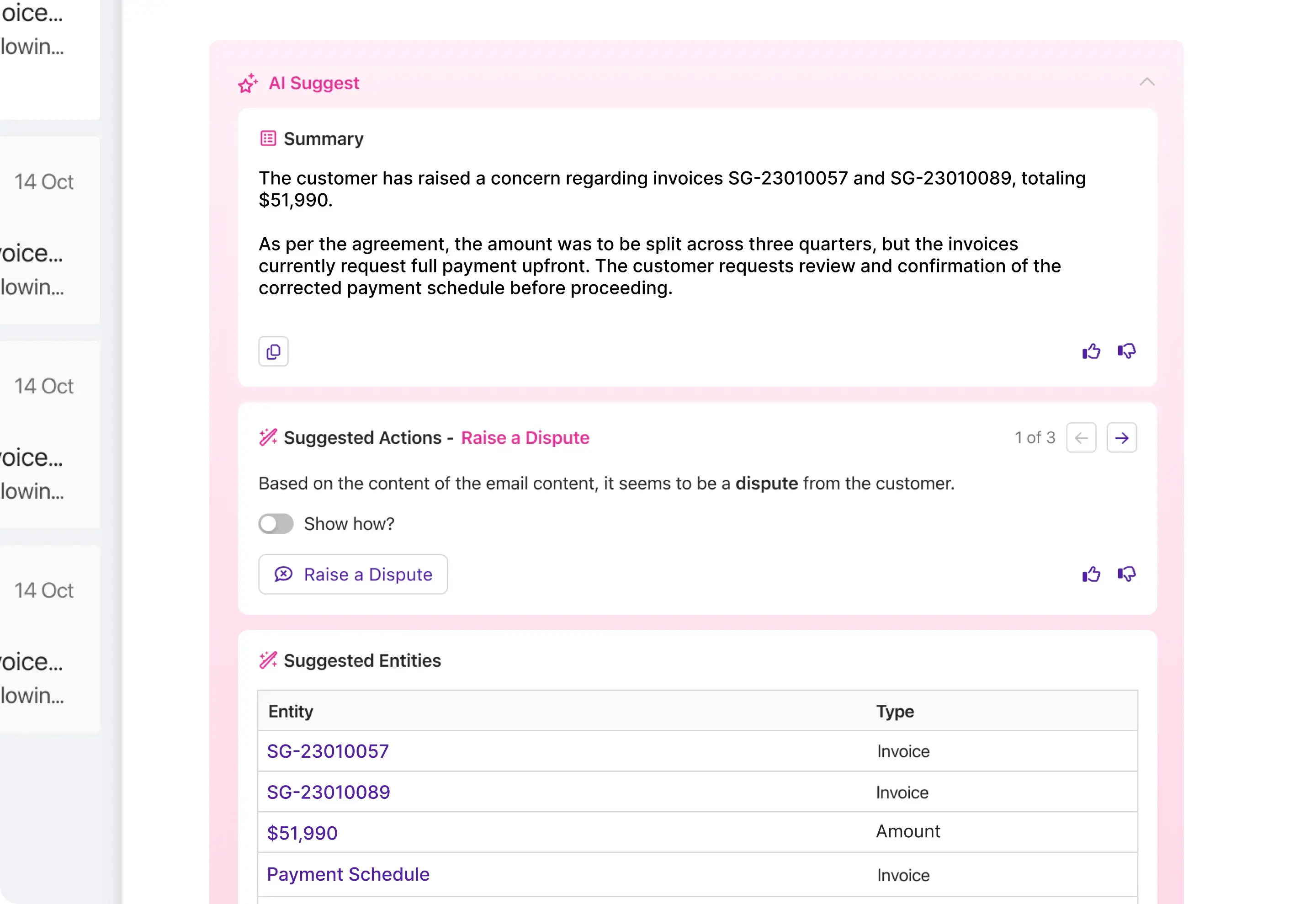
These decisions behave like statistical gravity: the more volume you give them, the more accurate the model becomes. Humans introduce noise here: variation in judgement, inconsistent interpretation of remittance patterns, and emotional bias.
When AR teams force humans into these decisions, they don’t create quality. Instead, they create variance: an enemy of predictable AR. Machine-first doesn’t mean unsupervised. It means the system acts unless a confidence or context checkpoint is triggered.
Class 2: Machine-Supported Decisions
These are decisions where machines can propose an action, but; humans must authorize it because the context contains layers of nuance that are unobservable to data alone. This category is where most modern AR failures occur. Not because the technology is insufficient, but; because the organization has no defined structure for how and when humans should supervise automation.
Machine-supported decisions always involve contextual ambiguity, such as:
- Adjusting a customer’s risk tier because of business model shifts
- Modifying dunning strategy during a product launch or seasonality spike
- Assigning responsibility for cross-entity disputes
- Rerouting an account due to relationship sensitivity
These decisions sit at the intersection of historical behavior, commercial intent, and current organizational priorities which aren’t available in ERPs or inboxes. Machines can surface options, patterns, and probabilities. They can’t resolve the intent behind the behavior and eventually shadow decisions erode both auditability and revenue governance.
This category is where confidence thresholds are most essential: automation must know when to stop.
Class 3: Human-Only Decisions
These decisions involve commercial stakes, contractual interpretation, reputational impact, or situations where ambiguity is so high that human judgement is the only defensible path. These decisions determine cash timing and strategic customer relationships.
For example:
- Negotiating settlements or concession terms
- Deciding how to handle recurring disputes tied to product or contract misalignment
- Authorizing write-offs or adjustments that affect revenue recognition
- Handling escalations that cross Legal, Sales, and Finance boundaries
This category is where human checkpoints are valuable and non-negotiable. No AI model - no matter how advanced - can interpret commercial nuance or political exposure inside enterprise relationships.
Why does this classification matter at scale?
When leaders fail to classify AR decisions correctly, three outcomes appear:
- Humans perform Class 1 work, driving up cost and creating variance
- Machines perform Class 2 work unsupervised, driving risk and error
- Class 3 decisions dissolve into email threads, eliminating auditability
And; if more than 30-40% of your AR team’s time is spent on Class 1 work, you don’t have a talent problem, you suffer from an architecture problem.
Part 2: Incorporating the Confidence Threshold Mechanism
Every decision the system makes must have a confidence score attached. The system must act and must also know when it shouldn’t act.
A simple threshold architecture:
- >90% confidence: automatic execution
- 70–89%: checkpoint queue
- <70%: mandatory human review
For example: A misclassified dispute with 78% confidence shouldn't auto-route to collections. It must enter a checkpoint queue, or it will distort DSO and dispute aging.
This solves the biggest operational risk of automation: confident mistakes. Confidence thresholds turn automation from a black-box into a supervised system. They also set the stage for the next part: checkpoints.
Part 3: Building Checkpoints Across the AR Journey
Most AR workflows fail not because teams lack discipline, but; because there isn’t any agreed upon structure based on which decisions are made, verified, and/or escalated. That’s where checkpoints come into the picture. They convert Accounts Receivable from reactive communication to an engineered system of governance.
Below is the expanded architecture:
Layer 1: Intake Checkpoint
Modern AR generates thousands of inbound signals: payment notices, remittances, disputes, apologies, status updates, legal claims, vendor-portal alerts, and credit holds. In inbox-based workflows, all these signals arrive unfiltered. This forces the Collector to both interpret the signal and act on it. This is slow, error-prone, and structurally risky. The intake checkpoint creates a separation between signal interpretation and decision action.
What the system must do at intake:
- Classify every inbound email or file into a standardized schema
- Enrich the message with ERP context (customer, entity, invoice)
- Detect contradictions (e.g., customer claims payment made; ERP shows none)
- Populate preliminary risk indicators
- Attach historical conversation context
When humans must intervene:
- Classification confidence drops below threshold
- The message contradicts financial system data
- The customer belongs to a strategic revenue band
- There is ambiguity between dispute vs inquiry
What this solves:
The intake checkpoint eliminates the most costly AR pattern: humans reading every email as if every email carries equal weight. It turns interpretation from a human task into a systemic filter and ensures humans only touch decisions that matter.
Layer 2: Commitment Checkpoint
The most fragile part of AR is the verbal or written promise-to-pay (PTP). In inbox workflows: PTPs live inside threads, there is neither system-level ownership, nor prediction on reliability, and commitments disappear when team members leave. Commitment checkpoints convert ephemeral messages into trackable commitments with a lifecycle.
What automation must do at commitment:
- Extract PTPs and link them to invoices
- Compare customer behavior against historical promise reliability
- Predict fulfillment probability
- Identify conflicts with credit policies
When humans must intervene:
- The promise is ambiguous
- The predicted reliability is below tolerance
- The customer has a history of escalated disputes
- The commitment changes expected cash projections
What this solves:
This checkpoint turns the most volatile AR element into structured data. It directly improves forecast reliability and cash-projection accuracy. Without this, AR forecasting is narrative driven. With this, forecasting becomes governed intelligence. While automation can bring 32% DSO improvements, it can only take you halfway; checkpoints are what make the gains sustainable and governable.
Layer 3: Escalation Checkpoint
Inbox workflows obscure time. A dispute can sit for 5 days or 25 days. Leadership only discovers the delay when revenue recognition deadlines or quarter-close pressures appear. Escalation checkpoints convert time from a passive measurement into an active trigger.
What automation must do at escalation:
- Monitor all open PTPs, disputes, and unanswered messages
- Apply SLA rules (eg., “no response in 3 days → recommended escalation”)
- Detect stagnation in multi-entity workflows
- Recommend optimal action path for functions: Operations, Sales, Legal, or Customer Success
When humans must intervene:
- Contract terms require strategic handling
- Multi-entity disputes involve internal politics
- Escalation intersects with long-term customer value
What this solves:
This checkpoint eliminates the failure where AR decisions drift without action. It creates a governance layer where time is a background condition and an accountability trigger. This is where you can attack and lower the current conversion of invoice to a cash period of 20 days.
Layer 4: Resolution Checkpoint
The final checkpoint ensures every closure - whether payment, adjustment, or write-off - carries full decision lineage. For CFOs, this is the checkpoint that finally makes AR forecastable, auditable, and defensible.
What automation must do:
- Log every system decision, threshold breach, and human approval
- Provide an explainability snapshot for each resolution
- Attach all related communication and historical behavior
When humans must intervene:
- Any override of a system recommendation
- Adjustments affecting revenue recognition
- Write-offs involving operational or commercial root causes
- Resolutions involving special pricing or one-time concessions
What this solves:
This is the checkpoint that turns AR from an operational black-box into a governed system of record for decision-making. Without this layer, AR forecasts can’t withstand audit or board-level scrutiny. With this layer, AR becomes predictable, explainable, and strategically credible.
Before vs After: How Checkpoints Reshape a Collector’s Day
This is where architecture becomes reality.
Remember: the global firm with 5 ERPs, 3 shared inboxes, and the 45-day DSO problem, where nobody including the CFO can reconstruct what happens? With Intake + Escalation + Resolution checkpoints, those disputes would have been routed, escalated, and lineage-captured. This changes both cash outcomes and board conversations.
This isn’t better automation; this is an entirely different operating model.
The Ultimate 90-Day AR Transformation Plan
.webp)
Step 1:
- Conduct a 2-3 week audit of the top 50 recurring AR decisions across one region or business unit
- Classify each as either Class (1/2/3) based on whether they’re machine/human led
This inventory becomes your blueprint: it tells you where checkpoints must exist and where automation cannot operate unsupervised.
Step 2:
- Choose a pilot region with moderate complexity and high email volumes
- Configure an intake checkpoint that auto-classifies 70-80% of inbound messages and routes low-confidence classifications to a human
- Install a commitment checkpoint that converts PTPs into trackable objects with owner, timestamp, and reliability score
Some of the success metrics for this would be 70%+ accuracy of intake classification, 100% PTP capture rate, and 20-30% reduction in manual email triage.
Step 3:
- Setup three confidence bands where automation executes for confidence > 90%, while <70% constitutes a mandatory human review.
- Build a weekly dashboard showing: volume of decisions in each confidence band, % of decisions escalated due to low confidence, error rate of high-confidence automated actions.
Your goal at the end of 90-days is not accuracy; it is visibility into where AI needs human inspection.
Step 4:
- Define one clear escalation SLA; for example: any dispute which is unresponded to for 72 hours should automatically trigger an escalation to the owner
- Define one resolution lineage; for example: every adjustment, write-off, or overridden recommendation must record the decision owner, rationale, and supporting communication
Some of the success metrics here could be percentages of escalations triggered on time, percentages of resolutions with complete lineage, and average time to resolution reduction.
The Checkpoint Test
CFOs don’t need a transformative program to evaluate AR workflow design. They only need to ask one question:
“If I removed my email inbox tomorrow, which AR decisions would still be controlled, auditable, and explainable?”
If the answer is “almost none”, you don’t have an AR visibility problem; you have an AR architecture problem.
Perfect AR is not 100% automation.
Perfect AR is an architected system where automation handles scale and humans govern the ambiguity. That’s the real modern AR operating model. One that restores predictability, strengthens governance, and gives leaders something AR has not offered in years: confidence consistently.


.webp)
.webp)

.webp)
.webp)