

.png)
.webp)


.webp)


.webp)


.png)
A pre-webinar perspective for enterprise finance leaders
Accounts Receivable has always been judged on outcomes: cash collected, exposure contained, disputes resolved, DSO reduced. But inside most organizations, AR is still run as a series of disconnected activities: reports pulled after the fact, follow-ups sent in bulk, escalations triggered late, and forecasting shaped by best effort rather than reliable signals.
That model doesn’t scale. Not with today’s transaction volumes, customer complexity, and executive expectations around working capital predictability.
In our upcoming product masterclass “A Day in the Life of a High-Performing AR Team in 2026”, we’ll walk through what changes when AR moves from “getting through the month” to operating as a disciplined, measurable system. This blog is a preview of that day, structured by the way AR teams and finance leaders experience how processes work.
Early Morning: Visibility that enables decisions; not explanations
Enterprise finance leaders don’t need more dashboards. They need fewer surprises.
Yet many AR organizations begin the day with limited clarity: collectors working from spreadsheets, managers stitching together a view from ERP exports, and leadership asking questions that rarely get a confident answer. That uncertainty has a direct cost. When AR starts the day without a clean, current view of risk and priorities, the team’s best hours are spent assembling context instead of acting on it. Most organizations don’t realize how much capacity is consumed by work that doesn’t move cash: chasing status, reconciling lists, re-prioritizing midstream, and escalating issues too late to change the trajectory.
In a high-performing 2026 operating model, early morning work begins with a clear, shared truth:
- Total AR position and exposure
- Movement since the prior day
- Accounts and invoices that matter today
- Early warning signals (behavior changes, disputes, broken commitments)
- A prioritized plan that is already aligned across roles
Collectors can see their daily target, current performance, and the accounts with the highest risk-adjusted value. AR managers can see the full receivables book with DSO, CEI, and emerging risk indicators, without waiting for manual updates. Senior leaders get a high-level exposure snapshot that supports fast decisions, not additional questions.

Morning: Risk identification that prevents late-stage escalation cycles
Most overdue invoices are not the same problem. Treating them as if they are is one of the fastest ways to create operational churn.
In many organizations, “prioritization” is still driven by aging buckets: 30, 60, 90+, with activity organized around what’s oldest rather than what’s most likely to impact cash. That approach creates noise and hides the invoices that carry the real risk: the high-value disputes, the accounts with shifting payment behavior, the invoices stuck in approval loops, and the promises-to-pay that quietly break without visibility.
A modern AR operating model treats risk as a signal-driven discipline:
- Which customers are trending toward delinquency based on behavior patterns?
- Which high-exposure accounts have unresolved disputes or repeated delays?
- Which invoices are likely to slip this week unless action changes?
- Where are collections efforts being diluted across low-impact tasks?
The objective isn’t to “do more follow-ups.” It’s to intervene earlier and more precisely, while the outcome is still controllable.
Late Morning: Outreach strategy with customer intelligence, not repetition
Late morning is where enterprise AR teams either strengthen relationships or silently damage them.
The common failure mode is simple: volume-driven outreach with limited context. Collectors send reminders because they must, but without a complete picture—payment history, dispute status, prior conversations, and customer-specific policy—those reminders often become easy to ignore.
For leadership, the risk isn’t just slower collections. It’s customer experience drift. High-value accounts start experiencing inconsistent messaging, fragmented interactions across collectors, and escalations that feel arbitrary. That friction eventually reaches the revenue side of the house.
A high-performing AR team in 2026 treats outreach as coordinated communication:
- Prioritized by account risk and value
- Informed by dispute status and prior interactions
- Consistent with customer-type policy and enterprise standards
- Optimized for resolution, not just “touchpoints”

This is where workflow intelligence becomes a strategic lever. When conversation history and account context are visible in one place, collectors spend less time reconstructing the past and more time driving the next best action.
For enterprise leaders, the takeaway is clear: better outreach is not a training issue. It’s a systems issue.
Midday: Collections execution without the operational drag
Midday is where AR performance is won or lost—not because it’s a dramatic moment, but because this is where capacity is either preserved or consumed.
In most organizations today, midday work is dominated by operational overhead:
- Disputes tracked across email threads
- Cash application visibility arriving late
- Manual follow-up scheduling
- Status updates requested, delivered, and re-requested
- Worklists constantly rebuilt as new information appears
This creates a productivity illusion: the team is active, but outcomes don’t move proportionally.
In a 2026 AR operating model, collections execution is designed to remove the hidden tax:
- Follow-ups run through structured workflows
- Dispute progress is visible end-to-end
- Cash application updates in near real time
- Invoices are connected to context, not just due dates
- Tasks are prioritized automatically based on behavior and risk signals
The difference for leadership is significant. This structure reduces dependency on individual heroics, stabilizes performance across teams, and improves forecast confidence. When execution becomes repeatable, scaling AR doesn’t require scaling chaos.
Early Afternoon: Exception handling that treats signals as opportunities
Early afternoon is when “exceptions” typically surface through broken promises-to-pay, disputes stuck without ownership, and high-exposure customers showing signs of stress.
In many organizations, these signals are discovered too late because the system is not designed to elevate them early. That delay turns manageable issues into urgent escalations, pulling managers into high-friction coordination work and forcing leadership attention onto items that should have been contained earlier.
High-performing AR teams handle exceptions as a controlled process:
- Broken PTPs appear immediately as priority events
- Stalled disputes are flagged with ownership clarity
- High-exposure accounts trigger structured escalation paths
- Next actions are suggested based on context and policy
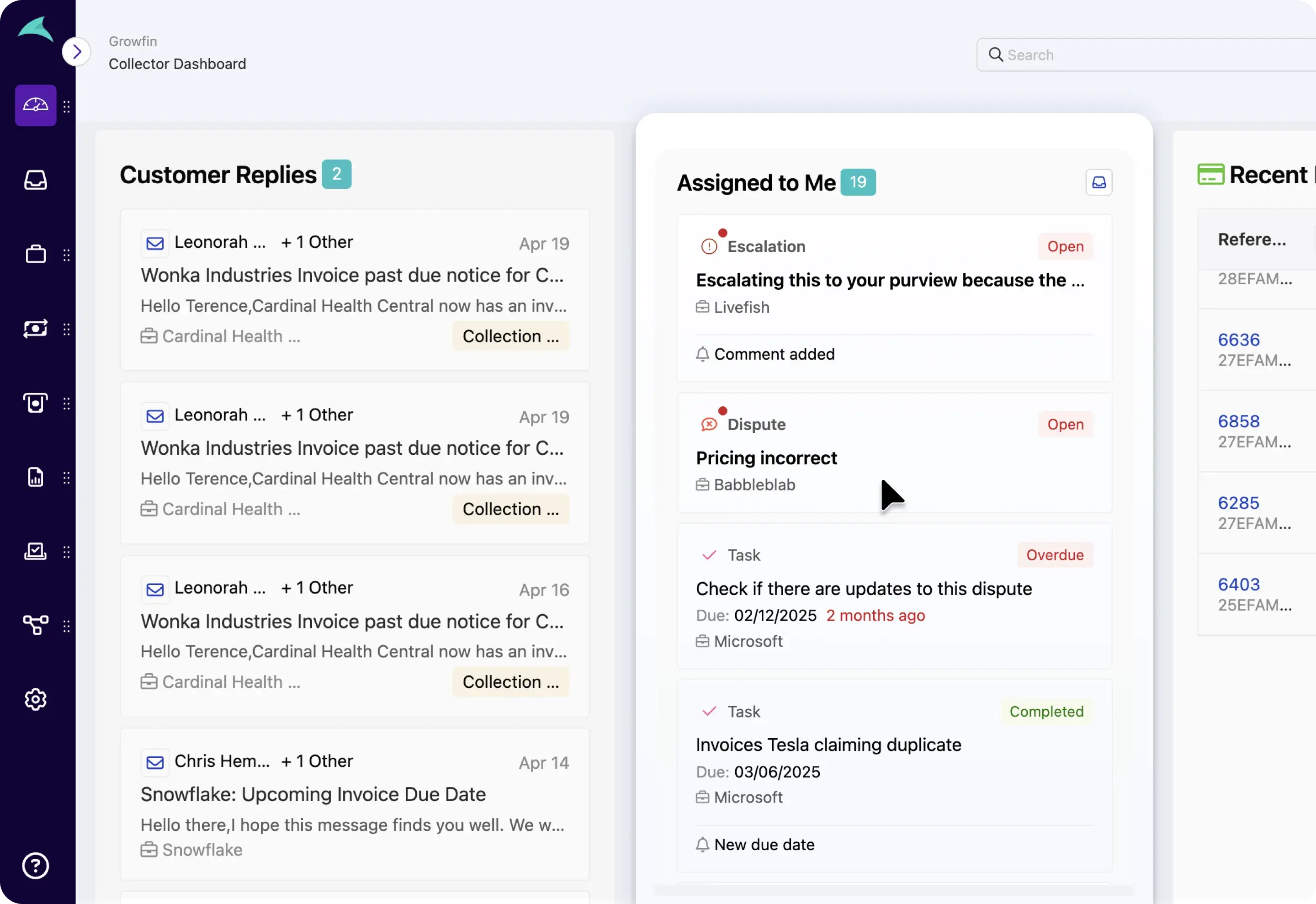
The result is not only faster resolution. It’s fewer cross-functional disruptions. When exceptions are addressed early, they don’t metastasize into end-of-month crises, and leadership involvement becomes more strategic.
Late Afternoon: Escalation and credit decisions with consistency and auditability
Escalation is often where enterprise AR loses discipline. Not because teams don’t care, but because most escalation mechanisms are informal.
A collector escalates based on intuition. A manager responds based on availability. Credit decisions vary depending on who is in the room. Over time, the organization builds inconsistency into how it manages risk.
That inconsistency matters. It affects revenue protection, customer relationships, and audit confidence.
A modern AR operating model treats escalation as governance:
- Structured thresholds define when to escalate and to whom
- Account exposure changes trigger review requirements
- Customer-type policies guide messaging and next steps
- Actions and context are captured in a traceable workflow
Close of Day: Forecast readiness that eliminates the “month-end cliff”
If the end of the day still feels unclear, the month-end will feel unstable.
The pattern is familiar: the team works hard all day, but leadership still doesn’t have clean confidence in what will close, what will slip, and where exposure is rising. Forecasting becomes a narrative exercise, shaped by partial information and cautious assumptions.
In 2026, the close of day looks different because the entire day is structured around forward visibility:
- Progress against daily targets is measurable
- Risk-weighted exposure is continuously updated
- Dispute and payment commitments are reflected in forecast views
- Trends and systemic issues are visible early enough to address

What you’ll take from the webinar
This masterclass is not just about collecting faster. It’s about operating AR differently, through a system designed for enterprise requirements: predictability, control, and scalable execution. You’ll be able to understand how the best-performing AR teams in 2026 are using Growfin to redefine:
- Daily visibility and prioritization
- Risk identification and early intervention
- Outreach consistency and customer experience alignment
- Dispute workflow control and resolution speed
- Exception handling and escalation governance
- Close readiness and forecast confidence
If you’re responsible for working capital outcomes, customer risk, enterprise cash predictability, or collecting cash faster, this session is designed to be practical, not conceptual. We’ll walk through the day step by step, anchored in what execution should look like when AR is run as a system. Join us for “A Day in the Life of a High-Performing AR Team in 2026.”


.webp)
.webp)

.webp)
.webp)