

.png)
.webp)


.webp)


.webp)



Spreadsheets continue to anchor Accounts Receivable (AR) because they offer a type of visibility that systems have historically failed to provide. As an AR leader, you trust them because they can be opened, inspected, corrected, and reconciled quickly: a reassuring level of control in a function where cash flow, DSO, customer relationships, and forecast accuracy are under constant scrutiny. The problem isn’t that spreadsheets are manual. It is that spreadsheets freeze AR at a moment in time when AR itself doesn’t stand still.
The instant an aging report, dispute log, or collections worklist is exported, it begins to drift from reality. Customer replies, partial payments, escalations, and risk cues continue to arrive. But; the spreadsheet remains static. What looks current is already outdated. And; AR decisions: who to follow up with, what to escalate, how to model cash, are based on these outdated snapshots. This timing gap isn’t a tactical nuisance; it becomes a structural distortion that affects collections performance, liquidity expectations, financial close, as well as customer relationships.
This distortion has grown more costly as AR has become faster, more complex, and more interconnected. Today’s AR operations span multiple entities, currencies, payment channels and complex contractual terms, with customers interacting across email, AP portals, automation systems, and service touchpoints. Payment cycles fluctuate more unpredictably. FP&A’s planning windows have shortened. Treasury depends more on AR inputs for near-term liquidity decisions. In this environment, spreadsheet-timed data can’t keep pace with the functions that depend on it.
This is the heart of the AR problem: spreadsheets still create the appearance of control, but; the control they offer is backward-looking. They allow teams to reconstruct what happened. They don’t manage what is happening now. And; as AR complexity rises, this backward-looking architecture becomes increasingly incompatible with the function’s financial responsibilities. This leads directly to the misconception that has shaped AR strategy for years: the belief that the solution is simply “more automation.”
The Myth that Keeps AR Stagnant: “Perfect AR is a Fully Automated System”
Spreadsheets don’t just obscure real-time AR conditions. They also obscure AR’s underlying complexity. When AR is viewed through static, spreadsheet-timed data: it appears far more predictable and linear than it truly is.
This naturally reinforces the belief that the function can be automated in the same way AP or transactional finance processes have been. The misunderstanding isn’t about automation’s potential; it’s about AR’s true nature. AR is shaped by incomplete signals, negotiation patterns, shifting payment behaviors, and contextual nuance that spreadsheets are unable to surface.
As a result, many organizations pursue automation as the primary path to AR maturity, assuming that variability stems from manual effort. But; the variability stems from judgment, ambiguity, and timing: factors that don’t disappear with automation and, when fed stale spreadsheet data, often worsen.
AR, however, is not a deterministic workflow. It is an interpretive function shaped by signals that can’t be easily automated or codified: partial or ambiguous customer responses, informal renegotiations, undocumented commitments, evolving disputes, and changing payment intentions. A rules-only model can’t reliably account for these nuances. And; since automation also inherits the timing flaws of the data feeding it; AR teams often have their AR automation system amplifying timing errors rather than correcting them. Fully automating AR without addressing temporal integrity increases the speed of misalignment; not the stability of outcomes.
Hence, perfect AR is not defined by the absence of human intervention. It is defined by the synchronization of human judgment and automation on a common, real-time data foundation. Automation provides scale and consistency; humans provide interpretation and governance. Both fail if they operate on stale or misaligned data.
Spreadsheets make that synchronization impossible.
The Temporal Integrity Framework: The Real Reason AR Underperforms
Accounts Receivable’s persistent volatility cannot be explained by operational discipline or tooling maturity, but through the lens of temporal integrity: the ability of AR processes to maintain fidelity with current conditions, alignment across teams, and coherence of downstream financial consequences.
Temporal Integrity consists of three dimensions:
1. Temporal Fidelity
This refers to how closely AR data reflects present-tense reality. When an aging report is exported into a spreadsheet, its fidelity begins to degrade immediately. Customer replies, partial payments, new disputes, credit escalations, and account-level nuances accumulate outside the sheet. By the time leaders review the report, the data may no longer accurately represent the system it describes. AR teams often feel this as unexplained DSO drift or inconsistencies between expected and realized cash.
2. Temporal Alignment
This describes whether different teams operate on synchronized versions of truth. Collections may use yesterday’s follow-up list. Cash Application works off today’s bank file. FP&A forecasts would be based on last week’s aggregate view. Treasury plans liquidity using rolling assumptions. Controllership reconciles using month-end snapshots. Each view may be internally accurate, yet the misalignment creates informational asymmetry. This asymmetry degrades trust and forces teams into defensive reconciliation rather than forward-looking planning.
3. Temporal Consequence
Timing discrepancies don’t accumulate linearly: they compound. A brief delay in dispute identification can push balances into aging categories where recovery probability falls sharply. A mis-sequenced follow-up can extend payment cycles by weeks. A slight mismatch between expected and actual receipts forces treasury into unnecessary liquidity buffers, inflating capital costs. These are not operational failures. They are timing failures whose financial effects become visible only downstream.
When spreadsheets are central to AR workflows, all three dimensions fail simultaneously. Processes can remain compliant, and teams can execute precisely, yet AR outcomes will remain unpredictable because the timing structure governing decisions is inconsistent with real-time conditions. Temporal Integrity (not automation level, process documentation, or team size) is the primary determinant of AR accuracy.
The Monetary Drag Curve: How Temporal Distortion Translates into Financial Cost
Temporal distortion in Accounts Receivable is not an operational nuisance. It’s a financial drag.
Once receivables lose real-time fidelity, the distortion ripples across treasury, FP&A, and controllership. The Monetary Drag Curve captures this through three forms of cost: liquidity drag, forecast variance drag, and governance drag.
Liquidity Drag arises when treasury cannot rely on AR’s timing. Based on the Atradius report, overdue invoices convert into cash an average of 20 days past due, creating uncertainty for near-term liquidity. Growfin’s 2025 benchmark report showed industry peer groups with 20-44 day DSO spreads, having $8-12 million in trapped working capital per $100m revenue.
Forecast Variance Drag appears when spreadsheet-driven AR forces FP&A to plan on mismatched clocks. Since collections, cash applications, FP&A are each using a differently dated version of the truth, the forecast becomes noise. With DSO varying by multiple weeks within the same sector, models cannot predict collection cycles. Variance becomes embedded into the system.
Governance Drag appears at month-end, triggered by incomplete reconciliation processes leading to audit friction. Earlier, there was a Gartner report which mentioned 40% of journal entries were manual due to mistrust in AR data; a burden that originated from AR’s fragmented, spreadsheet-driven processes.
Across all three axes, the conclusion is the same: monetary drag is the financial cost of expired truth. Restoring AR’s temporal integrity is the only way to eliminate it.
Hybrid Intelligence Architecture: A Structural Alternative to Spreadsheets
Eliminating spreadsheets is not a matter of adding a system which provides near-accurate visibility in real-time. It requires redesigning AR around Hybrid Intelligence: a model that integrates human judgment and automation within a shared, real-time data environment.
Hybrid Intelligence begins with categorizing AR decisions into three groups:
Deterministic decisions, such as scheduled reminders or standard payment matching rules, where automation can operate reliably when data is current.
Semi-structured decisions, such as dispute triage or follow-up strategy, where automation can provide recommendations but human verification is essential.
Judgment-intensive decisions, such as credit overrides or exception handling, where human experience cannot be replaced and should not be diluted.
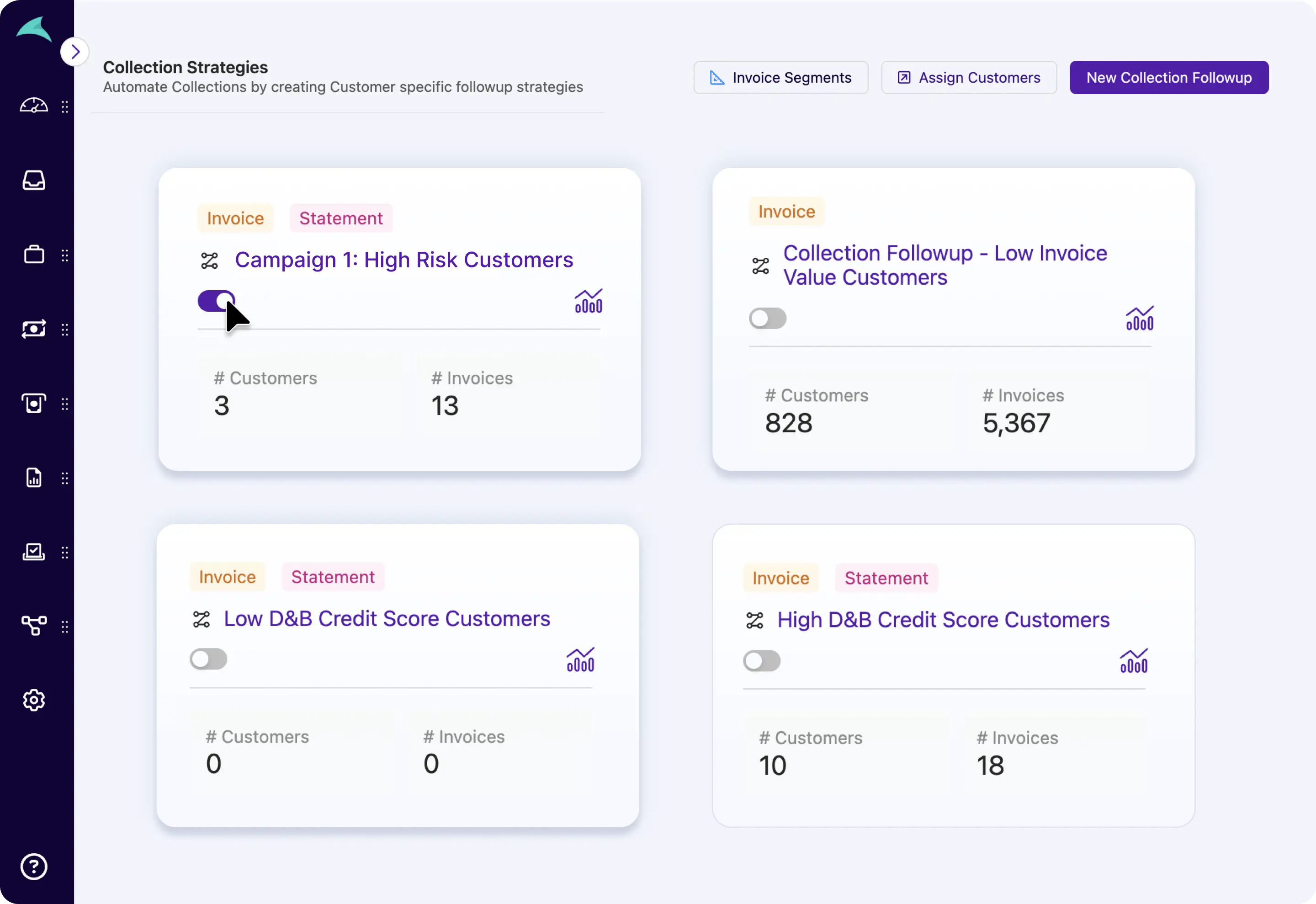
For Hybrid Intelligence to work, AR systems must support continuous-state visibility, updating customer behavior, payments, disputes, and risk scores in real time so that judgment and automation operate on the same temporal baseline. Automated actions require confidence scoring, so low-confidence cases automatically route to human checkpoints. Every decision, automated or human, must carry explainability and ownership to maintain audit integrity and prevent the re-emergence of spreadsheet shadow systems.

This architecture aligns with Gartner’s future-of-finance projections: AI will not eliminate finance roles; it will shift them toward judgment-heavy responsibilities while automation handles scale and consistency. AR is an early proving ground for this transition because its performance depends on synchronizing nuance with volume; something spreadsheets cannot support.
Hybrid Intelligence is not a technological preference. It is a governance requirement.
What Finance Leaders Should do in the Next 90 Days
Transformation begins with governance rather than tooling. Finance leaders can start with five high-leverage interventions:
1. Conduct a Temporal Integrity Audit
Map where AR processes depend on spreadsheets, identify timing gaps, and evaluate how these gaps influence cash realization, forecast accuracy, and reconciliation cycles.
2. Map AR Decisions by Ambiguity Level
Categorize all AR decisions: from reminders to dispute escalation; by complexity, ambiguity, and risk. This becomes the foundation for AR decision rights.
3. Replace the Highest-Fidelity-Loss Spreadsheets First
Prioritize aging exports, dispute logs, cash application trackers, and collections worklists; the artifacts where temporal decay has the greatest financial impact.
4. Create Cross-Functional Temporal Alignment Rituals.
Establish weekly synchronization between AR, FP&A, Treasury, and Controllership to ensure unified views of expected and realized cash.
5. Design Explicit Human Decision Checkpoints.
Codify when and how human judgment overrides automated recommendations. This prevents the reintroduction of spreadsheets as unofficial override tools.
These interventions lay the foundation for Hybrid Intelligence and gradually remove the organizational dependency on spreadsheet-timed AR.
The Closing Imperative: AR Must Become a Real-Time Function
AR cannot remain a retrospective function in a financial environment that increasingly depends on forward-looking accuracy. Cash forecasting, capital planning, liquidity management, and financial reporting depend on an AR system that reflects current conditions, not reconstructed history. Spreadsheets cannot deliver this, regardless of how well teams maintain them.
Replacing spreadsheets is not about efficiency or modernization. It is about restoring temporal integrity and ensuring AR operates on information that is accurate, aligned, and contemporaneous. Perfect AR is not automation without humans. It is judgment and automation operating on the same temporal reality, supported by systems designed for the velocity and complexity of modern finance.
The organizations that achieve this shift will not simply accelerate collections or reduce DSO. They will strengthen governance, improve forecast confidence, reduce liquidity strain, and create an AR function capable of defending and enhancing financial clarity.
Perfect AR is not a myth. The myth is that automation alone will get us there. Tools like Growfin can help you take a step towards Perfect AR.


.webp)
.webp)

.webp)
.webp)