

.png)
.webp)


.webp)


.webp)


.png)
Multi-entity businesses rarely experience AR failure as a sudden event. There is no system outage, no dramatic spike that immediately signals something is wrong. Instead, the failure shows up as something far more insidious: a gradual loss of coherence.
Each subsidiary appears to be doing its job. Each region produces its own reports. Each AR team follows the workflows they were given. And; yet, when leadership asks what should be a straightforward question: “What is really happening with our receivables?”, the answer fragments.
It lives partly in ERP aging reports, partly in spreadsheets, partly in inboxes, and partly in the minds of the people who know which numbers to trust and which ones need explaining.
This isn’t just chaos caused by scale. It is complexity interpreted by systems that were never designed to understand complexity in the first place.
Why was this problem inevitable?
For a long time, finance leaders accepted an assumption that felt reasonable: the more entities a business has, the more fragmented AR naturally becomes. Different geographies, different customers, different payment behaviors; some level of mess was simply the price of growth.
That assumption held because the underlying systems never challenged it.
ERPs were built to act as systems of record. Their job was to capture finalized transactions, not to reason about behavior across entities or anticipate what would happen next. When interpretation was needed, spreadsheets stepped in. When exceptions arose, email became the coordination layer.
This patchwork worked when:
- Payment methods were limited,
- Customer behavior was relatively stable,
- Entity structures were simple, and
- Volumes moved slowly enough for humans to keep up
Modern AR no longer operates in that environment. Payments arrive through multiple channels. Customers pay across subsidiaries. Disputes span entities. Automation and AI are layered on top of data that is already fragmented.
How does multi-entity accounts receivable break?
Multi-entity AR fails in quieter ways that are easy to miss:
1. Fragmented risk and customer signals: Customers are assessed independently by each entity. This causes payment behavior, dispute history, and exposure to be evaluated in isolation. What looks healthy in one entity could be seen as economically risky across all entities
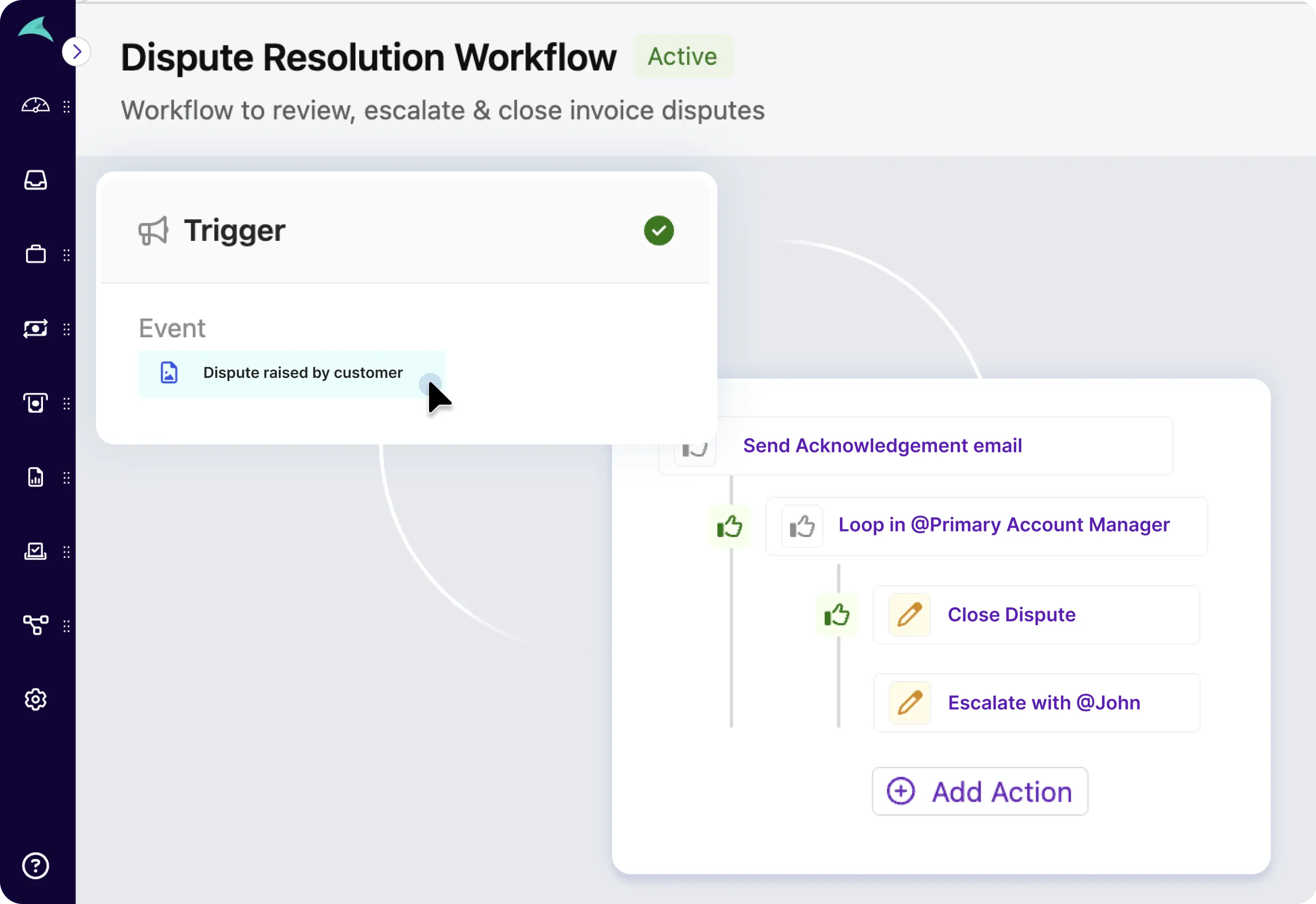
2. Non-propagating disputes and exceptions: Disputes and escalations raised in one entity do not automatically constrain actions in others. As a result, teams continue collections or credit decisions without awareness of blockers elsewhere
3. Loss of time integrity across entities: Cash may have arrived in the bank, but differences in posting workflows, and currencies create inconsistent timing across AR and forecasting. Decisions are made on different clocks
4. Informal commitments that never become system objects: Promises-to-pay (P2P), negotiated concessions, escalations, and manual adjustments live inside AR email inboxes and conversations. Instead of becoming governed, trackable objects with ownership and lifecycle
5. Irreversible loss of decision lineage: Weeks later, finance leaders cannot reconstruct why an action was taken, who approved it, or what information was available at the time
What is the shift needed to prevent such breakage?
Today, the real shift is this: From simplifying variance to supervising variance.
For leaders running multi-entity AR, the fastest way to cut through the noise is to ask: where does complexity currently break your ability to explain, predict, or govern?
You can answer that by looking at four layers and their criticality.
Layer 1: Signal Integrity
Ask yourself:
- Do we have a unified view of customer exposure across entities?
- Do disputes and exceptions propagate automatically across the organization?
- Does cash timing mean the same thing to AR, Treasury, and FP&A?
At this layer, failure means:
- Risk is misclassified
- Prioritization is noisy
- Leadership decisions are made on partial truth
This layer is critical. Without it, everything else is cosmetic.
Layer 2: Time and Ownership
Ask yourself:
- Can we see how long disputes, promises, and escalations actually sit across entities?
- Is ownership explicit at every stage or implied through AR email inboxes and manual memory?
- Do escalations trigger because of rules or because someone remembered to follow up?
This is where:
- SLAs are missed without alarms
- Commitments quietly expire
- Leadership discovers delays only after consequences appear
This layer determines whether AR is reactive or controlled.
Layer 3: Decision Governance
Ask yourself:
- Which AR decisions are automated today?
- Which ones require human judgment?
- Does the system understand the difference between the two?
If humans and machines operate without defined boundaries, two negative consequences occur:
- Humans do work machines should own; creating cost and variance
- Machines make decisions humans should govern; creating risk
At this layer, leaders should be able to answer:
- Why did we act this way?
- Who approved it?
- What information was available at the time?
Layer 4: Explainability and Learning
Ask yourself:
- Can we trace outcomes back to decisions?
- Do overrides improve the system or disappear into history?
- Does the system learn or do the same exceptions repeat?
How to Read This:
- If Layer 1 is weak, fix nothing else yet
- If Layer 2 is informal, automation will amplify drift
- If Layer 3 is undefined, AI will create governance debt
- If Layer 4 is absent, improvement will plateau
What does an ideal architecture for multi-entities ensure?
Once you accept that multi-entity AR is fundamentally an interpretation problem and have answered questions across the four layers, a specific set of operational capabilities becomes unavoidable. These are not features in isolation. They are the mechanisms that allow complexity to remain governable as the organization scales.
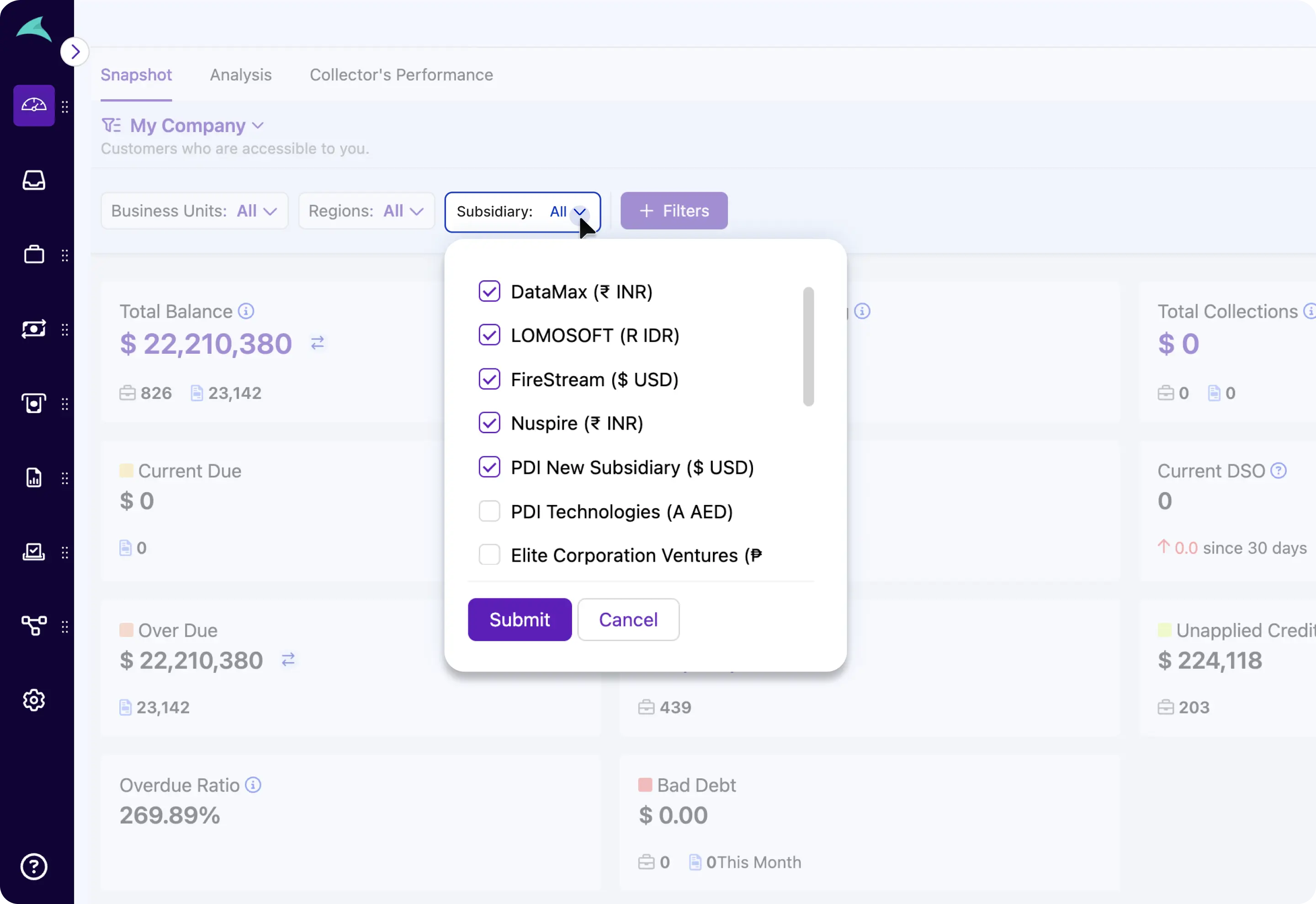
1. Unified visibility without forced simplification: Most multi-entity organizations already have visibility in some form. What they lack is a single surface where AR makes sense as a system, rather than as disconnected entity snapshots. Leadership sees roll-ups. Local teams see detail. The friction lives in between, where explanations are required.
An architecture designed for scale preserves both views simultaneously. It allows leaders to understand total exposure and trends, while retaining the ability to trace movements back to individual entities, customers, and decisions.
In practice, this means:
- Consolidated AR views that show balances, DSO movement, and cash trends across entities
- Parent-child customer hierarchies that reflect true exposure rather than legal fragments
- Drill-downs that preserve entity context instead of flattening it

2. Entity-specific execution without fragmentation: One of the quiet mistakes in accounts receivable transformation is assuming that standardization requires uniformity. In reality, forcing identical workflows across entities is what drives teams into workarounds.
Different entities operate under different payment norms, regulatory expectations, and commercial realities. A system that ignores this reality doesn’t create discipline; it creates shadow processes.
The alternative is structural consistency with behavioral flexibility. The underlying operating model remains coherent, while execution adapts where it must.
That shows up as:
- Collection strategies and follow-up cadences that differ by entity
- Custom stages and tags that reflect how work actually happens locally
- The ability to test and compare strategies across entities
3. Accountability that doesn’t rely on memory: In multi-entity AR, responsibility often dissolves across AR email inboxes, regions, and handoffs. When something stalls, no one is intentionally negligent, but ownership is unclear.
A system built for complexity encodes accountability instead of assuming it. Access, permissions, task assignment, and escalation logic are scoped explicitly by entity. Responsibility is visible at every stage.
This typically includes:
- Entity-level access controls that prevent accidental overreach
- Collector and manager views aligned to the entities they own
- Escalation rules triggered by time, value, or risk. Not by who happens to notice first
4. Cash application that doesn’t distort reality: Cash application is where multi-entity AR either holds together or quietly falls apart. Payments arrive through multiple banks, formats, currencies, and subsidiaries; often in ways that don’t align neatly with invoice structure.
When this process is manual or localized: AR data becomes unreliable before collections even begin. Downstream teams are forced to make decisions on blurred inputs.
A scalable architecture treats cash application as a shared intelligence layer. Payments are matched with awareness of entity boundaries and customer hierarchies. Unapplied cash is visible as a signal, not hidden as noise.
That requires:
- Entity-aware cash application across payment sources
- Centralized visibility into unapplied cash across business units
- Support for multi-currency and multi-jurisdiction complexity
When cash application is interpretable, everything downstream stabilizes.
5. Governance and explainability at scale: As automation increases, explainability becomes the limiting factor. Leaders don’t just need outcomes; they need to defend decisions.
A no-chaos AR system ensures that:
- Every automated action carries context and confidence
- Every human override is recorded with rationale
- Every resolution is traceable back to ownership and intent
This is what turns AR from an operational black box into a governed system of record for decision-making.
Final thoughts: What winning actually looks like
Perfect AR is an adaptive system state: where complexity is expected, ambiguity is surfaced, and control is designed. In multi-entity organizations, finance teams that win will be the ones that build AR systems capable of
- Understanding variance
- Supervising decisions
- Earning trust at scale
That is how complexity stops producing chaos. Not by disappearing, but by being governed deliberately.


.webp)
.webp)

.webp)
.webp)