

.png)
.webp)


.webp)


.webp)


In this episode of Heroes of AR, Pradyut Hande, Associate Director of Product Marketing at Growfin, sits down with Soumen Das, CFO at DosePacker, who oversees group financials across multiple healthcare entities. With a career marked by successful NASDAQ IPOs and multi-billion dollar fundraising rounds, Soumen brings a rare investor-side perspective to why accounts receivable management directly impacts company valuation.
PH: We're in a capital-constrained macro environment. Liquidity has tightened, uncertainty is growing. How has the CFO's mandate changed when it comes to working capital efficiency?
SD: A lot has changed. Previously, the focus was more on cost cutting and managing liquidity. In the current environment, you have macroeconomic uncertainties, inflation, and the AI boom all converging. These factors have the potential to disrupt business models that have worked for years, and they have serious ramifications on your customers and your vendors. CFOs are in the center of all of that. On a day-to-day basis, I have to tackle liquidity issues across the group, and I can relate to what's happening across the board.
The Two Levers: AR and AP Working Together
PH: What are the most effective levers for a CFO to protect and ring-fence cash flow?
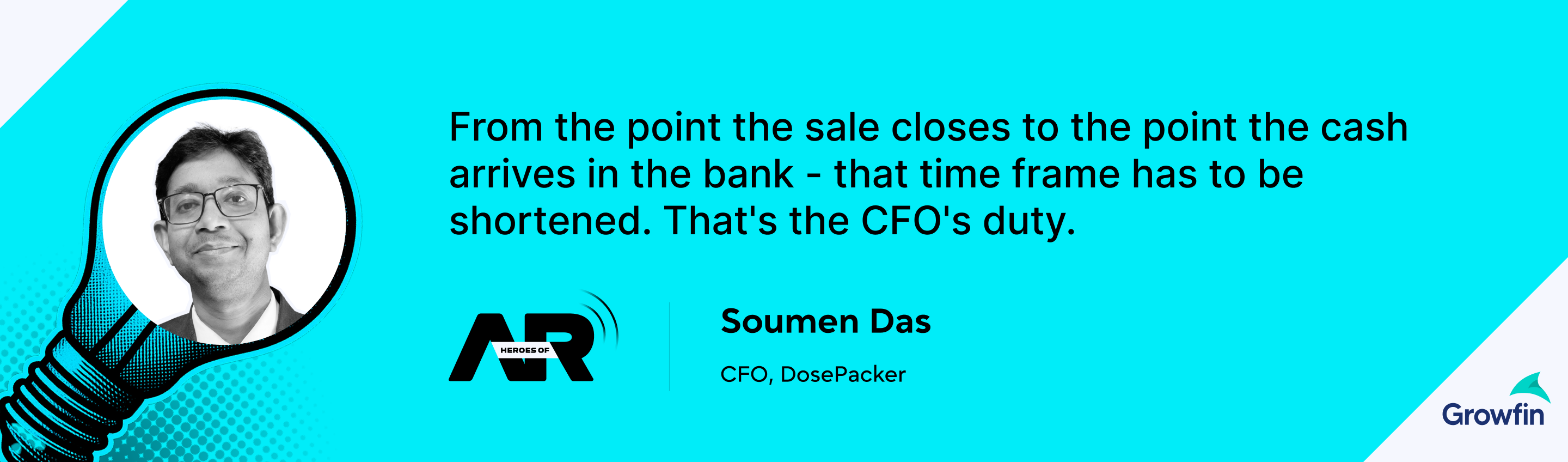
SD: You have to make sure you have full control over your accounts receivable and that you manage your accounts payable. On the AR side, it's the duty of the CFO to ensure collections happen on time. From the point the sale closes to the point cash arrives in the bank, that time frame has to be shortened. You can set up autopays, arrange prepaid terms, or ensure your highest-paying customers are collected from at a faster rate.
On the AP side, you need an excellent relationship with your vendors. You're not paying too fast, but you're not paying late either. You're balancing the two so that collections come in from customers and payments go out to vendors in a way that maintains liquidity. Balancing AR and AP is very important.
TL;DR - Cash flow protection requires active management on both sides: accelerating collections from customers while strategically timing payments to vendors. Neither AR nor AP can be an afterthought.
How AR Quality Impacts Investor Confidence and Valuation
PH: You've been part of multiple IPOs and fundraising rounds. How does the quality of receivables management influence investor confidence and valuation?
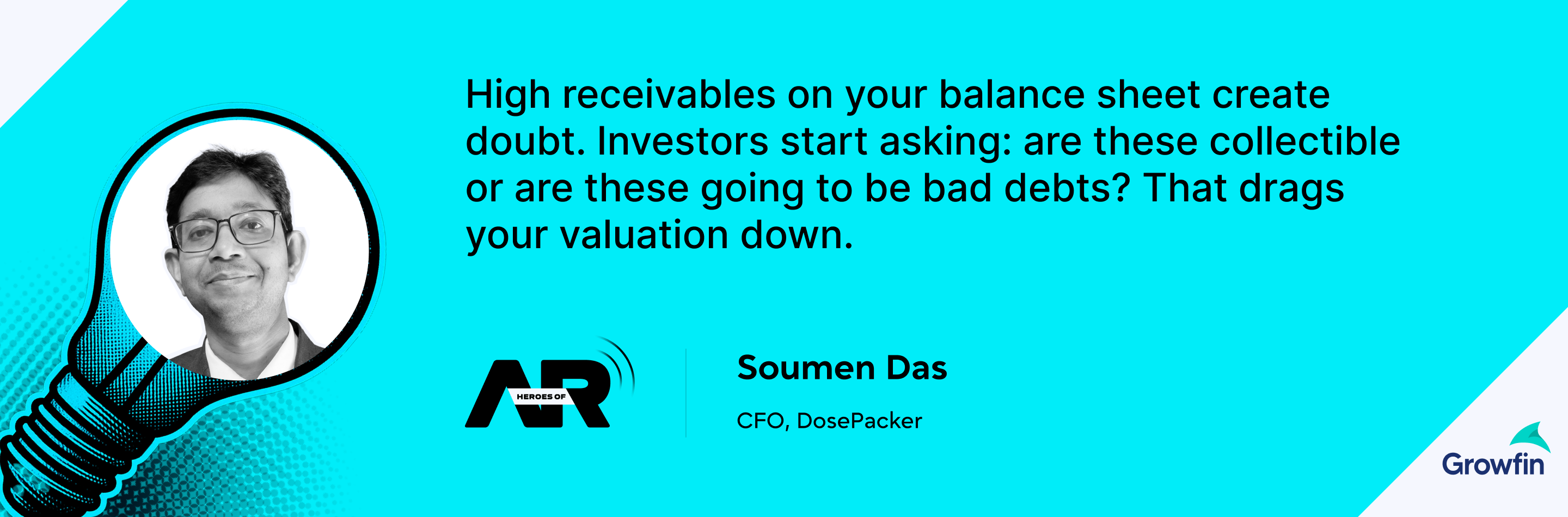
SD: Account receivable is definitely something investors look at. The first thing they examine is the AR aging report - 30 days, 60 days, 90 days. A company can have great revenues, but investors will also look at what's sitting in the accounts receivable column on the balance sheet. If you have high receivables, it means you're not collecting on time.
They'll dig into the aging report. The longer the period, the more it drags your valuation down, because it creates doubt about whether those amounts are actually collectible. If they're not, investors start viewing them as bad debts or doubtful accounts. That will absolutely reduce your valuation.
The second thing is collection efficiency - how fast you're able to collect relative to your revenue. That determines how investors view a company's AR, and it ultimately influences the valuation they're willing to assign.
TL;DR - Investors scrutinize AR aging reports and collection efficiency closely. High receivables with long aging periods signal collection risk and directly suppress valuation. Clean AR isn't just an operational win - it's a fundraising and exit advantage.
How AR Complexity Changes Across Industries
PH: You've held leadership roles across tech, healthcare, and energy. How does AR complexity change across these sectors?
SD: The financial operations are the same across industries, but customer profiles and collection sources are different. In healthcare, we have significant exposure to insurance companies. We collect a portion of our revenue from insurers, and those payments are not in our control. There's often a delay, and if the insurance is tied to the government, it delays collections further. That's the biggest challenge in healthcare.
In technology, you have customers working with you for years, subscription models, and recurring payments coming in monthly. You have clear visibility into incoming revenue. In energy, you don't have that subscription model, and you get paid after providing all services. If customers don't pay on time, it affects liquidity and business operations directly.
As for benchmarks, in technology the DSO is typically under 30 days, often within 15 days because of subscription billing. In healthcare, it can be two months or even longer depending on the scenario. Beyond DSO, you should also track AR turnover ratio, AR aging, and the collection effectiveness index to get a full picture.
TL;DR - AR complexity varies dramatically by industry. SaaS companies enjoy predictable, fast collections. Healthcare faces long, unpredictable cycles driven by insurance. Energy sits somewhere in between. The metrics are universal, but the benchmarks differ significantly.
Customer Risk Profiling for Smarter Collections
PH: How do you evaluate credit risk and how does it impact your AR management?
SD: We've categorized customers based on their payment patterns over the years. We've segmented them into different risk profiles - which are risky, which are reliable. Based on that profiling, we track what portion of our revenue we're actually able to collect and what portion is at risk at any given time.
We also maintain a buffer margin. If the probability of collection from certain customer categories is low, we determine whether we can still collect or whether we should write it off. We follow a specific process to reach a conclusion on each item at the AR level.
TL;DR - Segmenting customers by payment behavior and maintaining risk profiles helps CFOs identify at-risk revenue early and make faster decisions on collections strategy or write-offs.
AI as an Opportunity, Not a Threat
PH: There's still some skepticism around AI in AR. What's your take?
SD: AI is everywhere, not just in AR. Agentic AI is penetrating every part of the financial ecosystem, and we have to live with it. But instead of considering AI as a challenge, we should consider it as an opportunity to enhance our processes and make day-to-day financial operations more effective.
Technology tools that integrate seamlessly into accounting software to pull reports and initiate dunning processes for overdue customers - that's a great improvement over the old way of reaching out over the phone. AI is a boon to us.
TL;DR - CFOs who view AI as an opportunity rather than a threat are better positioned to improve collection efficiency, automate dunning, and enhance financial operations at scale.
Three Pieces of Advice for CFOs
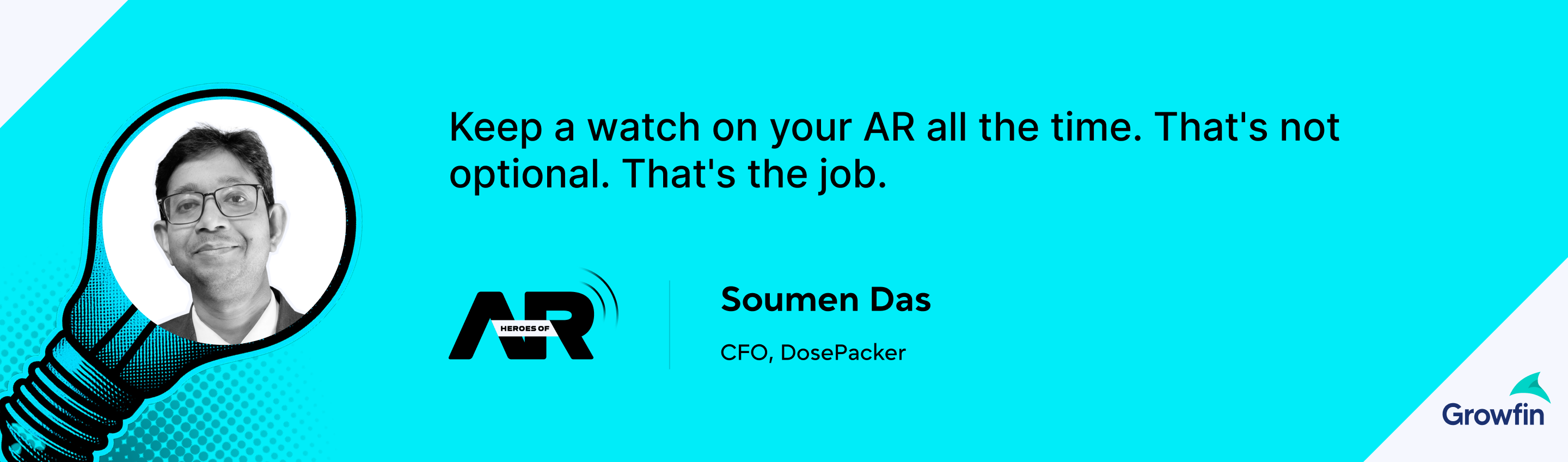
SD: First, make sure you have the right controls, processes, and checks and balances in place inside the group. Second, at the external level, keep proper track of your accounts receivable with customers and the billing team to ensure collections come in on time. Watch your AR all the time. Third, on the AP side, have proper contracts with your vendors. Pay them on time, but negotiate the best terms possible.
These three things ensure you have enough liquidity and processes that can sustain the challenges of an audit, whether you're a public or private company.
Final Takeaways
- AR and AP must work in tandem. Cash flow protection isn't just about collecting faster - it's about balancing the timing of collections and payments to maintain liquidity.
- Your AR aging report is your valuation scorecard. Investors use it to judge collectibility, and long aging periods directly suppress company valuation.
- Industry context changes everything. SaaS DSO can be 15 days; healthcare can stretch beyond 60. Know your industry benchmarks and manage accordingly.
- Profile your customers by risk. Segment by payment behavior, track what portion of revenue is at risk, and maintain buffer margins for low-probability collections.
- Treat AI as a lever, not a liability. Automation of dunning and collections workflows is no longer optional at scale.
Check out Growfin's collections and cash application solution, and start building your AI-driven AR processes.


.webp)
.webp)

.webp)
.webp)