

.png)
.webp)


.webp)


.webp)


.webp)
For a $500M company, every 5 days of excess DSO traps roughly $6.8M in working capital, according to the Growfin 2026 DSO Benchmarks Report. That money can't fund hiring, R&D, or expansion. It sits in accounts receivable, waiting.
The gap between top and bottom AR teams is wide. Yahoo Finance reports that the bottom 25% of companies spend 3x more than the top 25% to collect a single invoice. The difference is operational maturity: how the team is structured, what tools it uses, and how much of the process runs on manual judgment versus data and automation.
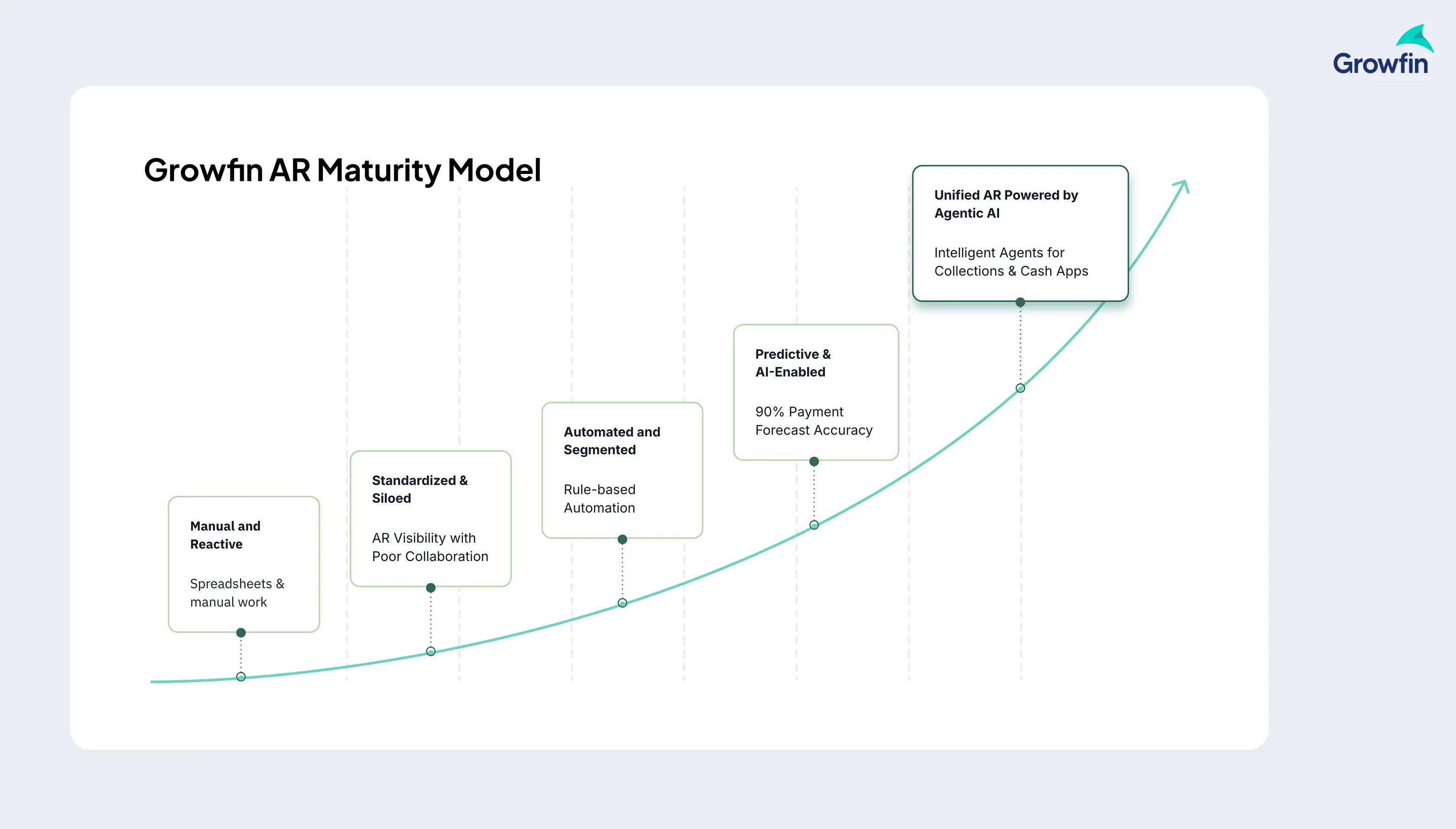
AR Maturity Model - 5 stages of AR Operations
The Growfin AR Maturity Model maps five stages of AR operations, from fully manual to AI-powered. This piece helps you identify where your team sits today and understand what it takes to move up.
Stage 1: Manual and reactive
What it looks like
Collections run on spreadsheets, shared inboxes, and individual judgment. There's no centralized view of who owes what, which accounts are at risk, or what follow-ups have been sent. Cash application is manual: someone opens a bank statement, finds the payment, looks up the invoice, posts it to the ERP. Disputes live in email threads.
The cost of staying
APQC benchmarks show bottom-quartile AR teams take 2 to 3x longer to process each collection action compared to top-quartile teams. At Stage 1, every task takes longer than it should because nothing enforces consistency or routes priority.
DSO drifts upward because follow-ups are inconsistent. Cash application backlogs delay financial close by days. Forecast accuracy suffers because nobody has a real-time view of expected inflows. The Growfin 2026 DSO Benchmarks Report found a 19 to 23 day DSO gap between top and bottom performers across industries. For a mid-market company doing $100M in revenue, that gap represents $5M to $6M in trapped cash.
What moves you to Stage 2
A single system of record for AR activity. Consolidate all customer communication, aging data, and collection status into one tool with basic reporting. The first step is visibility.
Stage 2: Standardized and siloed
What it looks like
The team has an AR platform or a structured process. There's visibility into aging, overdue accounts, and collector workloads. Basic reports exist. But the system operates in a silo. AR data doesn't flow into cash forecasting. Collections and credit run on separate workflows. The ERP gets batch updates.
The cost of staying
The team has data, but it's fragmented. Credit decisions don't account for collection history. Cash forecasts don't reflect real-time AR status. Reporting is backward-looking: you know what happened last month.
We've seen teams at this stage consistently underestimate their true cost-to-collect by 30 to 40% because siloed data hides cross-functional inefficiencies. The Kyndryl research finding that 71% of finance leaders acknowledge AI's value but aren't ready to trust it often reflects teams at this stage: they can see the problem, but the infrastructure isn't ready for the solution.
What moves you to Stage 3
Breaking the silos. Connect AR data to your ERP in real time (same-day sync, not batch). Give treasury and credit teams visibility into AR status. Build a shared view of customer risk that spans credit evaluation and collection behavior. Growfin's native ERP integrations (NetSuite, Sage Intacct, Microsoft Dynamics 365, SAP, QuickBooks) are built for this transition: bidirectional sync for invoices, payments, and disputes with same-day updates.
Stage 3: Automated and segmented
What it looks like
Collections follow rule-based workflows. Dunning sequences are automated: Day 3 reminder, Day 7 follow-up, Day 14 escalation. Accounts are segmented by aging bucket or dollar amount. Cash application uses basic matching rules. The system handles the routine. Analysts handle exceptions.
The cost of staying
Rule-based automation treats every account the same within its segment. A $500K account that always pays on Day 28 gets the same Day 7 reminder as a $500K account that's gone silent after raising a dispute. The rules can't distinguish between them.
Collection effectiveness plateaus. We've seen teams at this stage hit a ceiling where adding more rules creates complexity without improving outcomes. IOFM data suggests companies with standardized but static collections processes typically plateau at a Collection Effectiveness Index (CEI) of 70 to 75%, with the remaining gap requiring intelligence that rules can't provide.
What moves you to Stage 4
Adding intelligence to the automation. Replace static rules with live signals. Score accounts by payment behavior, not just aging. Prioritize follow-ups by likelihood of collection, not just dollar amount. Use AI matching in cash application to handle the exceptions rules can't cover. Growfin's dynamic health scoring (built on 14+ live behavioral signals) and SmartMatch AI for cash application are built for this transition.
Stage 4: Predictive and AI-enabled
What it looks like
AI models score accounts using live behavioral signals: payment timeliness, follow-up responsiveness, dispute patterns, promise-to-pay history. Cash application runs at 90%+ auto-match rates with confidence-driven posting. Cash flow forecasts incorporate real-time receivables data and reach 90%+ accuracy. The system predicts what's likely to happen next.
The cost of staying
You're capturing most of the value from AI within individual functions, but those functions still operate independently. Collections AI doesn't inform credit decisions. Cash application patterns don't feed risk scoring. The intelligence is deep within each function but shallow across the lifecycle.
Scaling still requires proportional headcount because the system recommends actions but a human executes each one. For teams processing more than 5,000 invoices per month, this execution bottleneck typically means 15 to 20% of AI-recommended actions expire before someone can act on them.
What moves you to Stage 5
Connecting the intelligence across functions and adding autonomous execution. Let the system act on its predictions within defined guardrails. Unify the data layer so a signal in cash application (a customer consistently short-paying) automatically adjusts the collection strategy and flags a credit review. Growfin's agentic AI architecture (Collection Agent, Cash Application Agent, Operator Agent) is designed to operate as a connected system across the full receivables lifecycle.
Stage 5: Unified AR powered by agentic AI
What it looks like
The entire receivables lifecycle operates as a connected system. AI agents handle collections execution, cash application, and dispute triage autonomously. They adapt strategies based on live behavioral data and learn from every outcome. Credit risk is monitored continuously. Cash forecasts recalculate on live signals. Human analysts focus on exceptions, strategic decisions, and relationship management.
PwC estimates AI-driven finance operations can cut costs by roughly 25% while delivering productivity and profit gains within 12 months. Teams at this stage are measured by outcomes per person.
Greenhouse automated 65% of collection tasks at this level. FourKites reduced time to collect by 45%. Air Comm achieved a 33% DSO reduction.
What keeps you here
Continuous learning. The agentic systems improve with every transaction, every human override, every resolved exception. The compounding effect means Stage 5 teams pull further ahead over time.
How to use this model
Don't try to jump stages. Each one builds on the data quality and process definition of the previous one. A team at Stage 1 that buys an AI-powered collections tool will struggle because the data isn't clean enough for AI to work well.
How to identify your stage
Answer these five questions. Your answers point to your current maturity stage.
- How does your team decide which accounts to follow up on?
Gut feel and aging reports → Stage 1 or 2. Rule-based segmentation (aging bucket, dollar amount) → Stage 3. AI-driven scoring based on payment behavior and risk signals → Stage 4 or 5.
- How does cash application work?
Manual lookup and posting from bank statements → Stage 1. Template-based matching with manual exceptions → Stage 2 or 3. AI matching with confidence scoring and auto-posting → Stage 4 or 5.
- How quickly does AR data reach your ERP?
Batch updates (weekly or end-of-month) → Stage 1 or 2. Daily sync → Stage 3. Same-day or real-time sync → Stage 4 or 5.
- How is your dunning strategy structured?
Ad hoc, based on individual collector judgment → Stage 1. Standardized cadence for all accounts → Stage 2. Segmented cadences by aging or dollar amount → Stage 3. AI-adjusted cadences by customer behavior → Stage 4 or 5.
- Can your credit team see real-time AR data when making credit decisions?
No → Stage 1 or 2. Partial visibility through manually shared reports → Stage 3. Full real-time visibility with AR signals feeding credit decisions → Stage 4 or 5.
Conclusion
If your answers cluster around a single stage, that's where you are. If they're split, you're in transition.
The most productive move is always the next stage. Identify where you are, understand what's holding you back, and invest in the specific capabilities that close the gap.
Find out where your AR team sits on the maturity curve.
Book a demo to see how Growfin accelerates the transition.
TL;DR
The Growfin AR Maturity Model has five stages: Manual and Reactive, Standardized and Siloed, Automated and Segmented, Predictive and AI-Enabled, and Unified AR Powered by Agentic AI. Each stage has a specific cost of staying and a specific set of capabilities needed to advance. Use the diagnostic questions above to identify your current stage. The most productive move is always the next one.

.webp)
.webp)

.webp)
.webp)